The Movement Room
Why your rep drifts at the end of the power reserve — and why the gen does too
By swissreptime · current as of September 2026
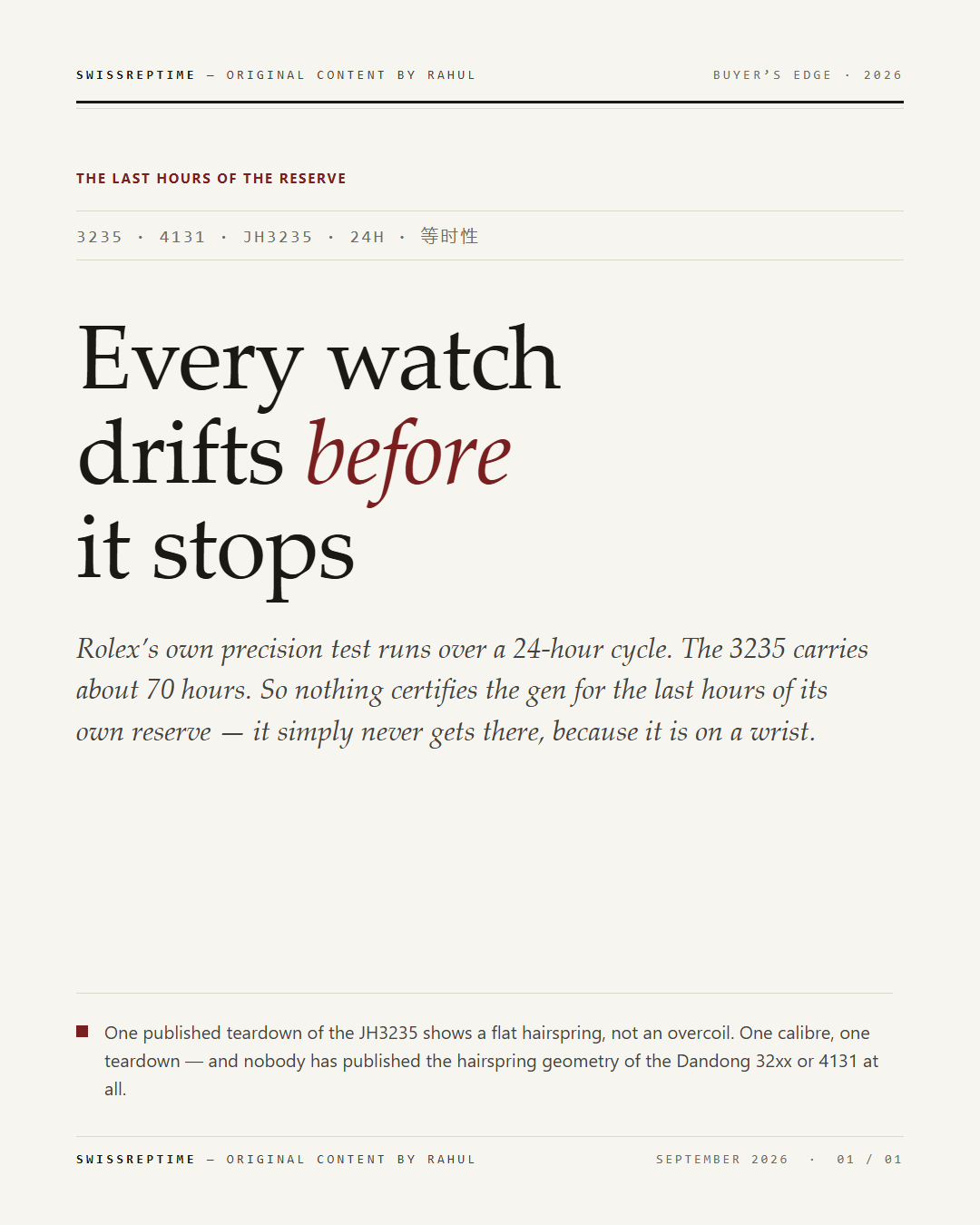
Every mechanical watch drifts before it stops, gen included — the gen just rarely gets there, because a wrist keeps winding it. Rolex certifies over a 24-hour cycle against a ~70-hour reserve, so nothing covers hours 24 to 70 on either side. The direction at the end is movement-specific and unmeasured. If it is losing minutes, that is a service, not geometry.
Someone here said it plainly this week: ideally the gens stop but the reps become slow. I replied like that was right. It isn’t, and this sub’s whole pitch is that we only say what’s confirmed — so I’d rather fix it in front of everyone than quietly. It was a good observation. The conclusion under it just doesn’t hold, and I helped it along.
No mechanical watch runs true and then stops dead. Not one. Every watch drifts before it stops, gen included. The gen just rarely gets there, because it is on a wrist and a wrist keeps winding it.
The difference between a gen and a rep here isn’t whether it drifts. It’s how much, and how predictably.
What is actually going on in there
Wound tight, the mainspring pushes hard. High torque, and the balance swings wide. As it unwinds the torque drops and the swing gets smaller. A perfect balance would keep exactly the same time at any swing — that’s isochronism, 等时性 in the Chinese threads. Real ones don’t, because the escapement has to touch the balance to keep it going, and every touch is a small shove. That shove doesn’t scale neatly as the swing shrinks. One patent in the literature, US 9134701, puts rate loss at small amplitude on the escapement — not on the shape of the hairspring’s end curve.
Falling torque means an unsteady rate. That part is physics, and no factory gets out of it.
Fast or slow? This is the bit I had backwards
The obvious story is: flat hairspring, so the watch loses time at the end. It’s tidy and everyone repeats it. It is also not what the published material says. The mainstream published account is that as amplitude falls a watch tends to run fast, not slow. Below a certain swing the escapement can flip it the other way and it runs slow. Which of those your watch does depends on the movement, the escapement geometry, and the state of the oils in it.
There is one published measurement, and it is worth knowing about. A watchmaker on r/RepTime ran a VS3235 across five positions at full wind, photographed every screen, and as the swing came down the rate went from dead on to about eleven seconds a day slow. So less swing, slower — on that watch.
But read what he is actually measuring. That is amplitude falling because of POSITION, with the mainspring still fully wound. It is not the watch running down. He says so himself in the next paragraph.
So we do have a data point for “less swing, slower” on one VS3235. What nobody has published — in either language — is the same movement measured at full wind and again near the end of its reserve. That is the specific gap, and it is narrower than I first wrote it.
So when someone says reps go slow at the end, they’re telling you what their watch did. Maybe theirs does. It isn’t a rule, and it isn’t geometry.
The drift is real. The direction is a guess until somebody posts numbers.
The overcoil, said properly this time
Gen 3235: blue Parachrom hairspring, four gold Microstella nuts, balance sitting under a full traversing bridge, and an optimised Rolex overcoil. Rolex’s claim for that overcoil is regularity in any position. A position claim. Not a power-reserve claim.
It gets quoted — I’ve quoted it — as if the overcoil is the thing holding rate while the watch runs down. That is stretching the source past what it says. Positional regularity and end-of-reserve stability are two different problems, and the overcoil is only advertised against one of them.
On the rep side: one published teardown of the JH3235 shows a flat hairspring, not an overcoil. One calibre. One teardown. And the person recirculating it is the person who published it. That is thin evidence and I’d rather call it thin than round it up to “most reps”.
Nobody has published the hairspring geometry of the Dandong 32xx or the 4131 at all — not in English, not in Chinese. Don’t infer it from the JH3235. Different bench, different movement.
If you read Chinese threads, the words are 平游丝 flat hairspring · 上绕游丝 overcoil · 等时性 isochronism. Machine translation regularly mixes the first one up with 无卡度 (free-sprung), and they are not the same thing at all — 平 just means flat.
One teardown of one calibre is a data point, not a survey.
The fact that actually settles the gen comparison
This is the part I didn’t know until this week, and it’s the most interesting thing in the whole argument.
Rolex’s own precision testing runs over a 24-hour cycle. The 3235 carries about 70 hours of reserve; the 4131 about 72. So the gen’s own certification says nothing whatsoever about hours 24 through 70. The gen is not proven to hold rate at the end of its reserve either. Nobody ever tested it there.
It simply almost never goes there, because you wear it, and wearing it winds it.
So the honest version of the comparison is not “gen holds, rep drifts”. It’s: both drift, and only one of them is ever asked to.
On free-sprung, briefly, because it always comes up
A balance with no regulator index has no curb-pin play, which is one isochronism error it cannot have. That’s a real thing and it’s worth having. It is also one error out of several, and it says nothing about what the escapement does at a small swing. Removing a source of error is not the same as fixing the rate at the end of the reserve.
“So should I demagnetise it?”
Yes. Do it anyway. It takes seconds, it costs nothing to try, and magnetism is a leading cause of low amplitude — which is the exact condition in play here. Anyone telling you not to bother is overcorrecting.
But know what magnetism actually looks like: it makes a watch run fast, and it does it all the time — not only in the last hours. That’s your free diagnostic. If your watch is fine for two days and only goes odd in the final stretch, magnetism isn’t the whole story, and you’ve learned something real for zero effort.
One more, because it saves people money: if you’re losing minutes, stop reading about hairsprings. Minutes is a fault, or a watch on the edge of stopping. Geometry does not cost you minutes. That’s a service.
What to actually do about it
Wind it before you judge it. A Monday morning reading taken off a Friday wind is the worst number that watch will produce all week, and it isn’t telling you what you think it’s telling you. Run the demagnetiser. If it’s minutes, book the service and skip the theory.
And here’s the thing I actually want from this sub
Nobody — in either language — has published a timegrapher reading of the same rep movement at full wind and again near the end of its reserve. That’s it. That’s the whole gap.
It is two photos. Same watch, same position, dial up both times. One reading at full wind. Put it in a drawer. One more reading three days later with a few hours of reserve left. Post both, say which calibre it is. Ignore whatever lift angle your machine is set to — the default is wrong for these movements and nobody agrees on the right one, but it only moves the amplitude figure, and the rate is the number we want.
That settles direction and magnitude for that movement in a week, for nothing, using a tool half of you already own. Wind it up tonight and take the first reading.
Current as of September 2026. The absence claims here were re-tested on 19 September against Chinese-language sources and still hold.
Read next: rep power reserve, explained · the VS3235 and VS3285 · what breaks, and who can fix it · the full index
Share your experience
Own a timegrapher? Two photos — same watch, same position, dial up, one at full wind and one near the end of the reserve — would settle this for your calibre. Post both and say which movement it is. Comments are moderated before they show.