The Review Desk
Cartier Santos-Dumont rep, sold as F1: hands-on review
By swissreptime · hands-on, November 2026
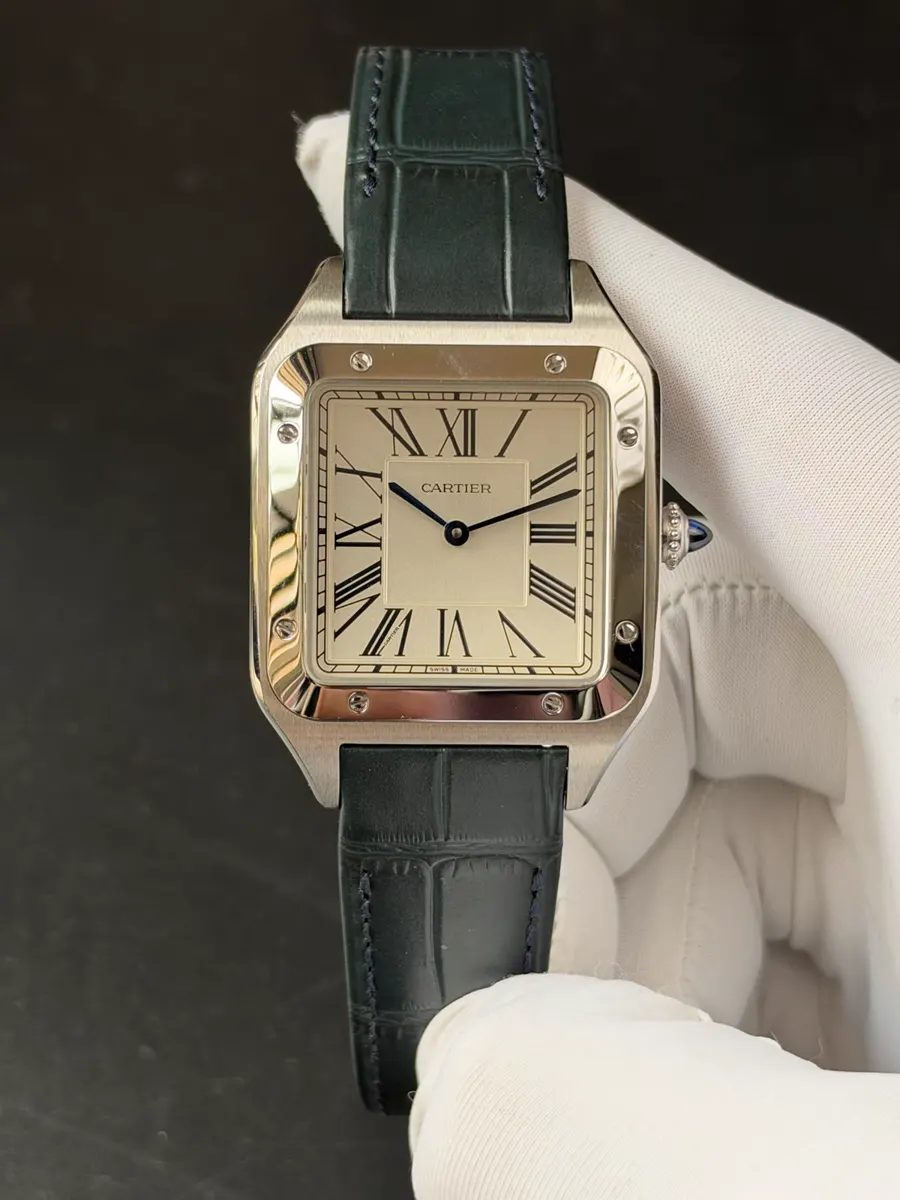
We stock this watch. We handled this exact piece; every photo is ours.
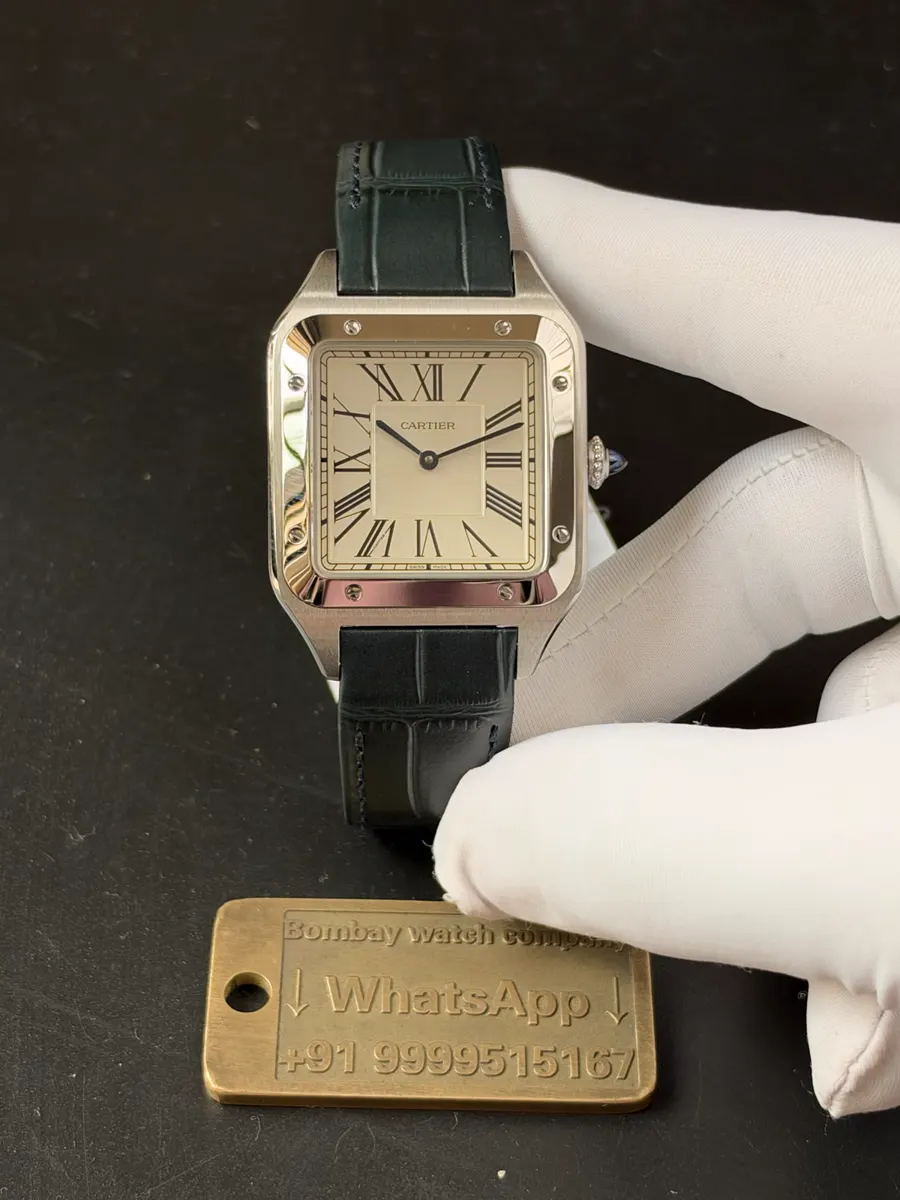
The brass Bombay Watch Company tag in our photos is there to show they’re ours, taken on this piece.
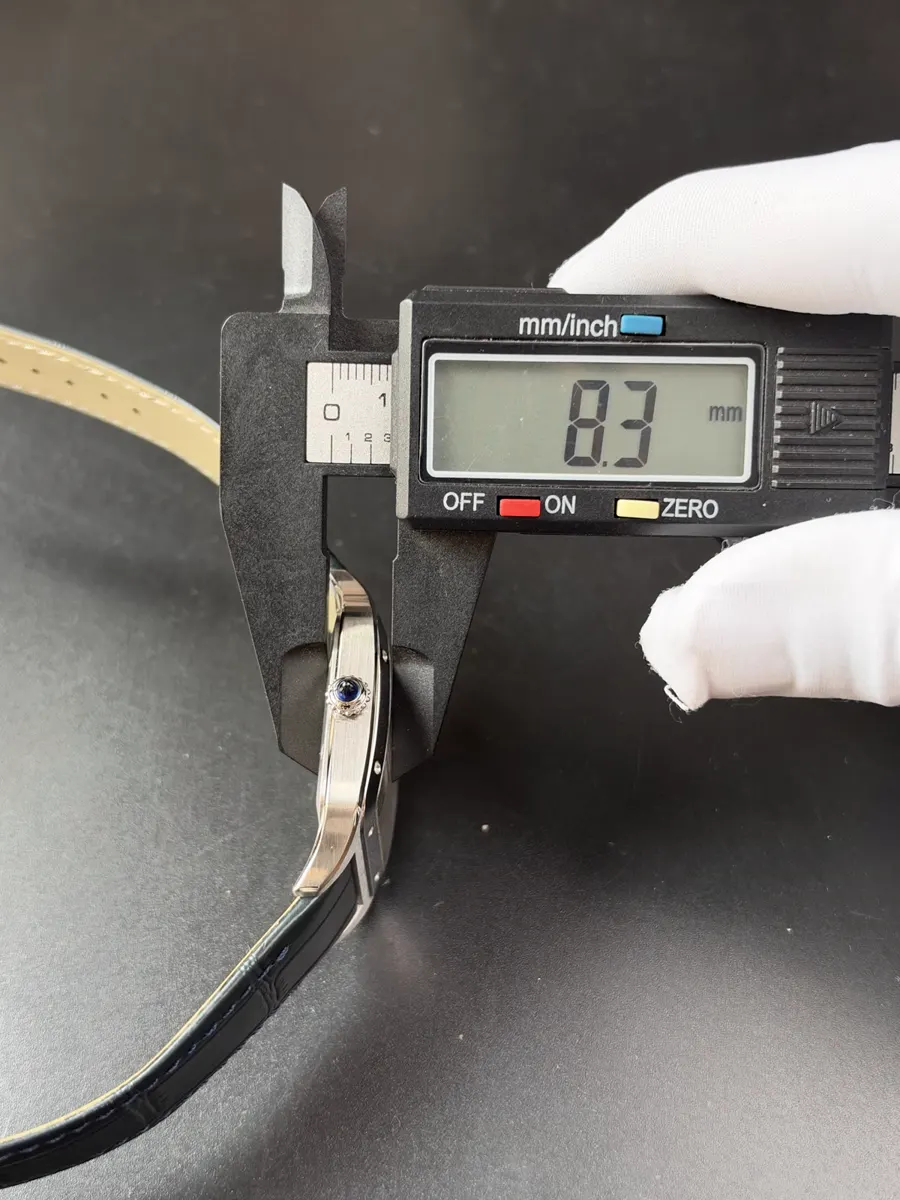
This is for someone who wants the Santos-Dumont’s flat square face, Roman numerals and blue cabochon, and who will mostly see it from the front. The dial is the best thing about it. Here’s the thing to know: on our caliper the case reads 8.3 mm. Cartier publishes 7.5 mm for the steel XL and 7.3 mm for the steel Large, so ours is 0.8 to 1.0 mm thicker depending on which size it copies. On a dress watch that difference is the one you’ll feel at the cuff.
What it is
- Reference copied: a steel Santos-Dumont with a silver Roman dial, blued sword hands and a beaded crown with a blue cabochon. The caseback says “mécanique”, and with this silver Roman dial in steel, the hand-wound version in Cartier’s current catalogue is the Extra-large model, WSSA0032. Cartier lists it at 46.6 x 33.9 mm and 7.5 mm thick, with the manual-winding calibre 430 MC, water resistance to 3 bar and a navy alligator strap. Cartier lists 38 hours of power reserve.
- The size question: we didn’t measure the length or width of this case, so we can’t yet say whether it’s built to XL or Large proportions. Cartier’s silver-dial steel Large (43.5 x 31.4 mm, 7.3 mm) is quartz. Cartier does make a hand-wound steel Large (WSSA0046, same 43.5 x 31.4 x 7.3 mm, calibre 430 MC), but with a black lacquer dial.
- Factory: F1. It reached us sold as F1, and we’ve since confirmed F1 as the factory we source this model from.
- Movement: we don’t know which base calibre is inside, and we haven’t opened the case. The caseback is solid, so nothing is visible. It’s not a Cartier 430 MC, and we won’t guess what it is. (What other owners say about it is in its own section below. None of it is our finding.)
Scorecard
Every score points to a photo. If no photo shows a category, it’s marked “not assessed”. Other owners’ reports don’t move these scores.
| Category | Score | Evidence |
|---|---|---|
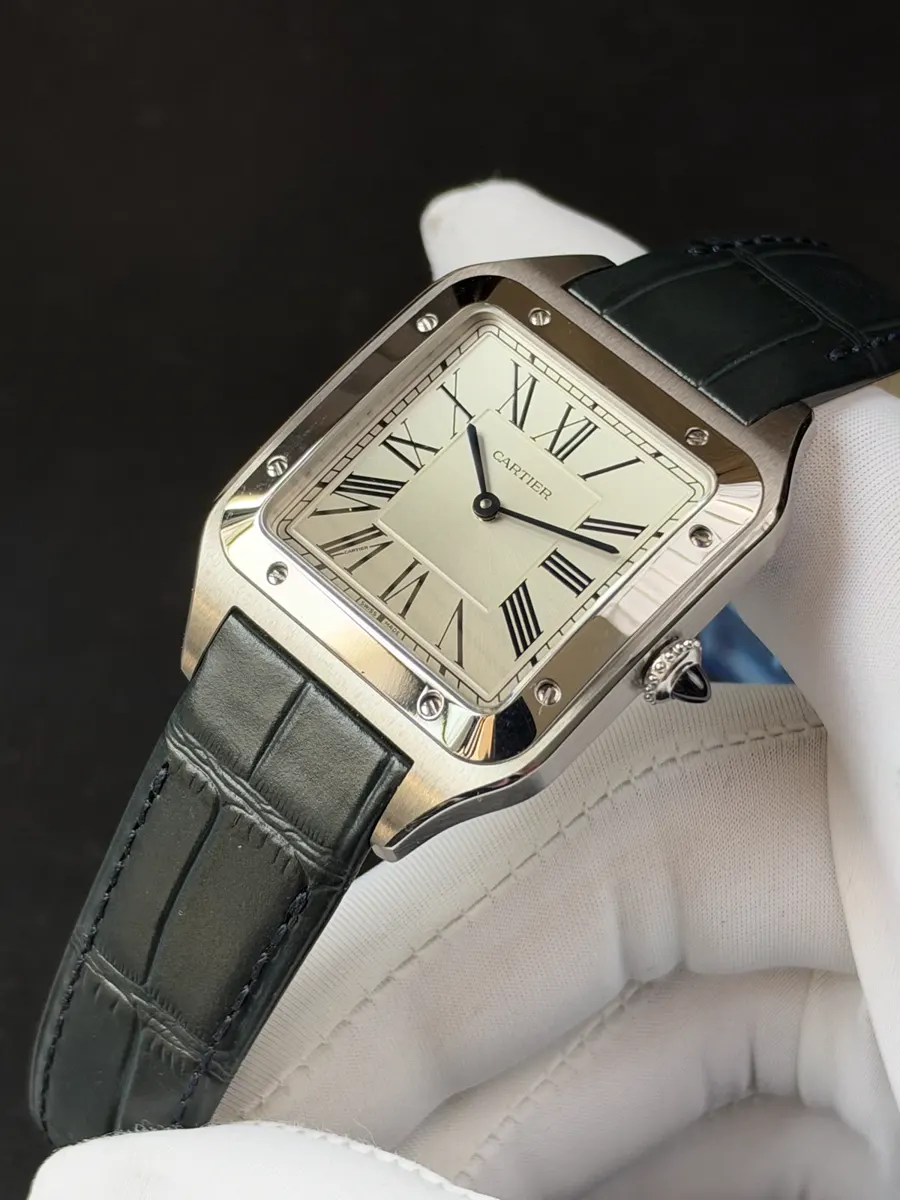
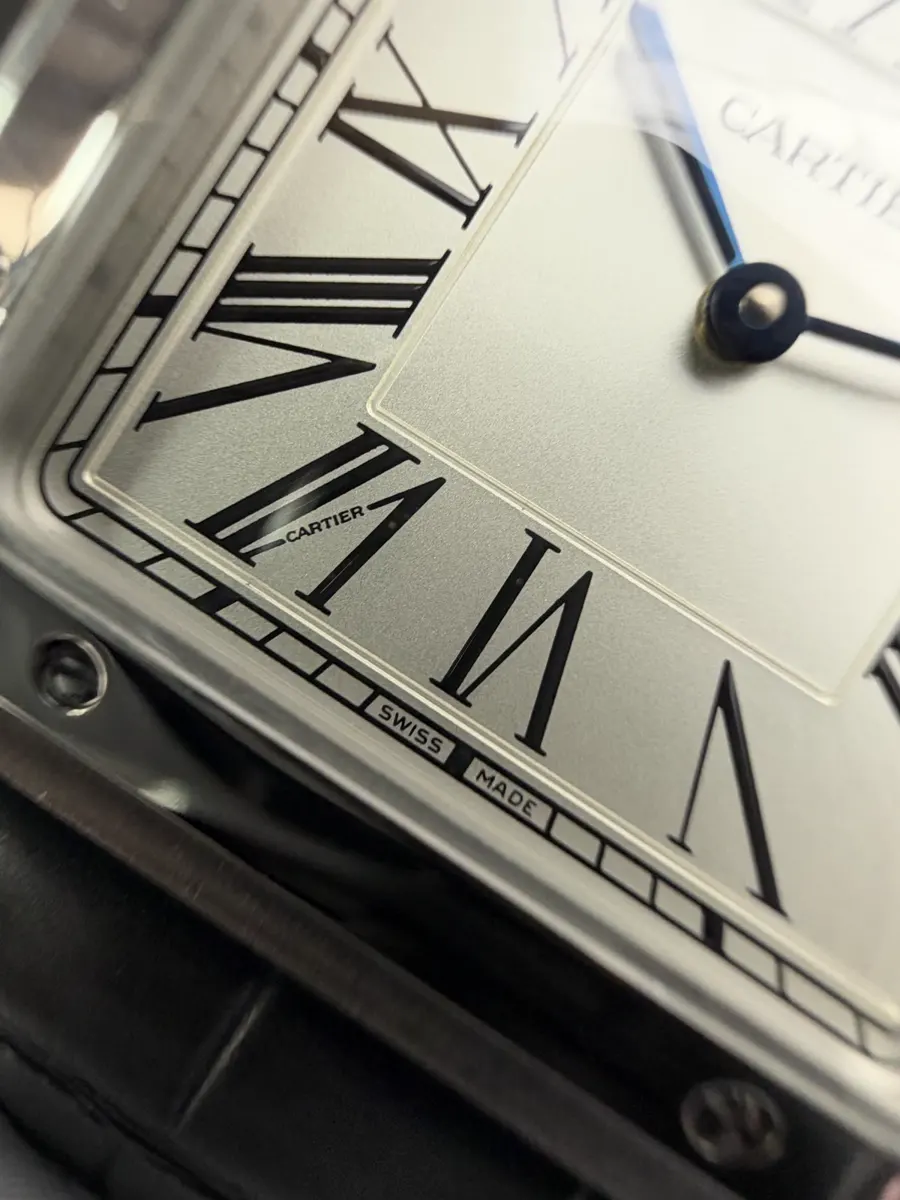
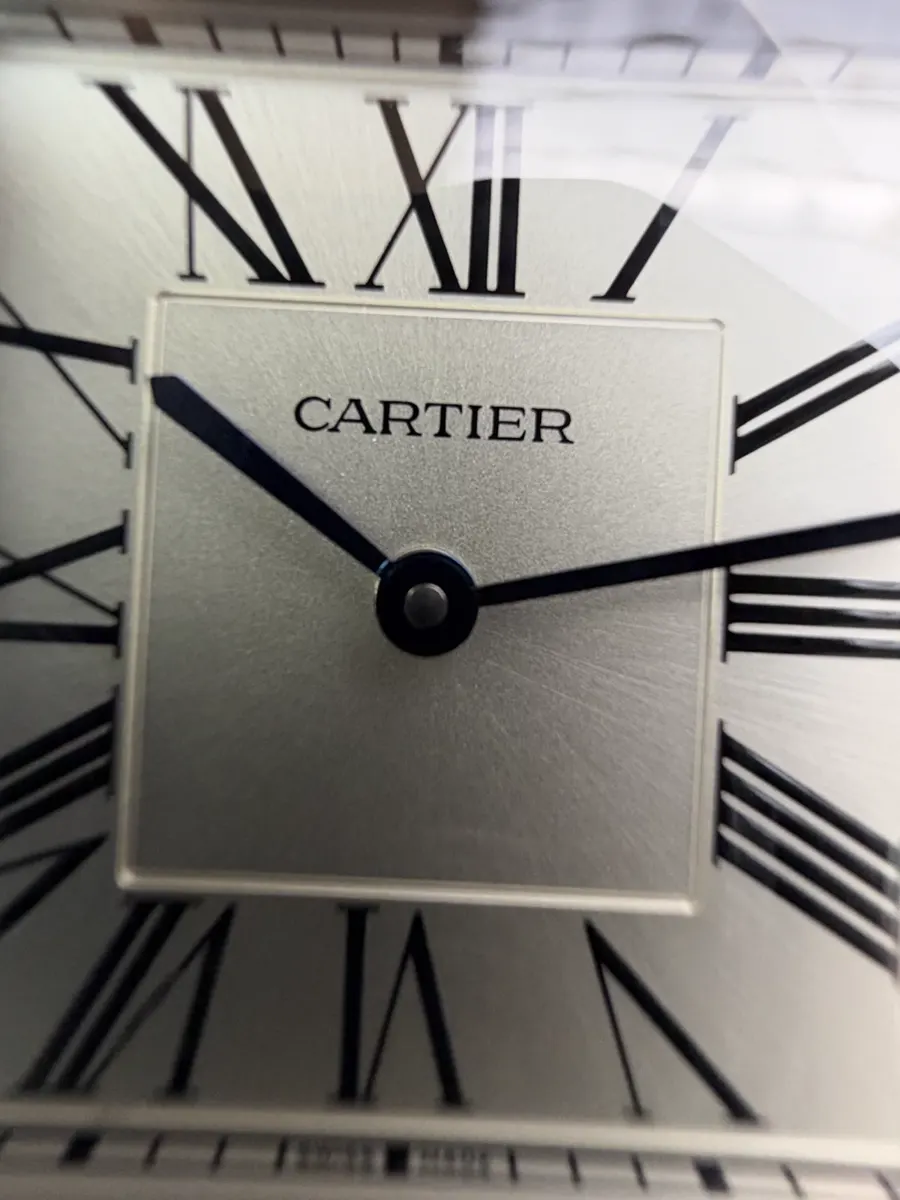
| Dial | 8/10 | IMG_2603: the Roman numerals have sharp edges, the rail-track minute ring is cleanly printed, “SWISS MADE” sits evenly in its gap at 6, and a tiny “CARTIER” is worked into the VII. IMG_2604: the CARTIER print in the centre square is crisp, and the raised square has a clean edge. IMG_2592, IMG_2601: everything is square to the case. We held back two points because nothing was compared side by side with a gen dial |
| Bezel | 8/10 | IMG_2592, IMG_2601: the polished bezel gives even reflections, the eight screws sit flush, and the inner edge is cut cleanly. The screw slots point in different directions (IMG_2592). We can’t source whether Cartier aligns them, so we noted it and didn’t mark it down |
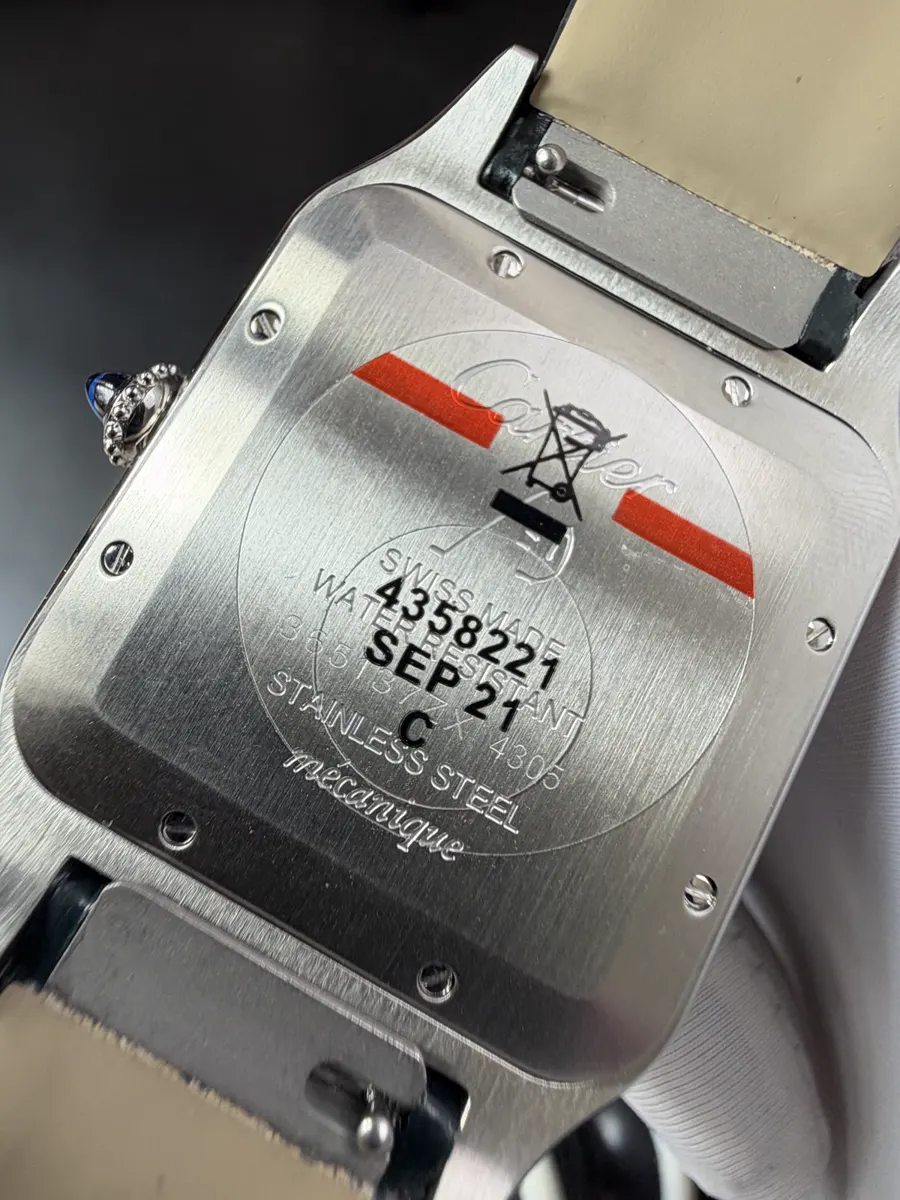
| Case & finishing | 6/10 | IMG_2593: brushed flanks meet the polished bezel along a crisp line, and the beaded crown and cabochon are clean. IMG_2602, IMG_2605: the caseback brushing is even and the eight screws are straight. IMG_2608: 8.3 mm on the caliper, against Cartier’s 7.5 mm for the XL. That gap is what limits this score |
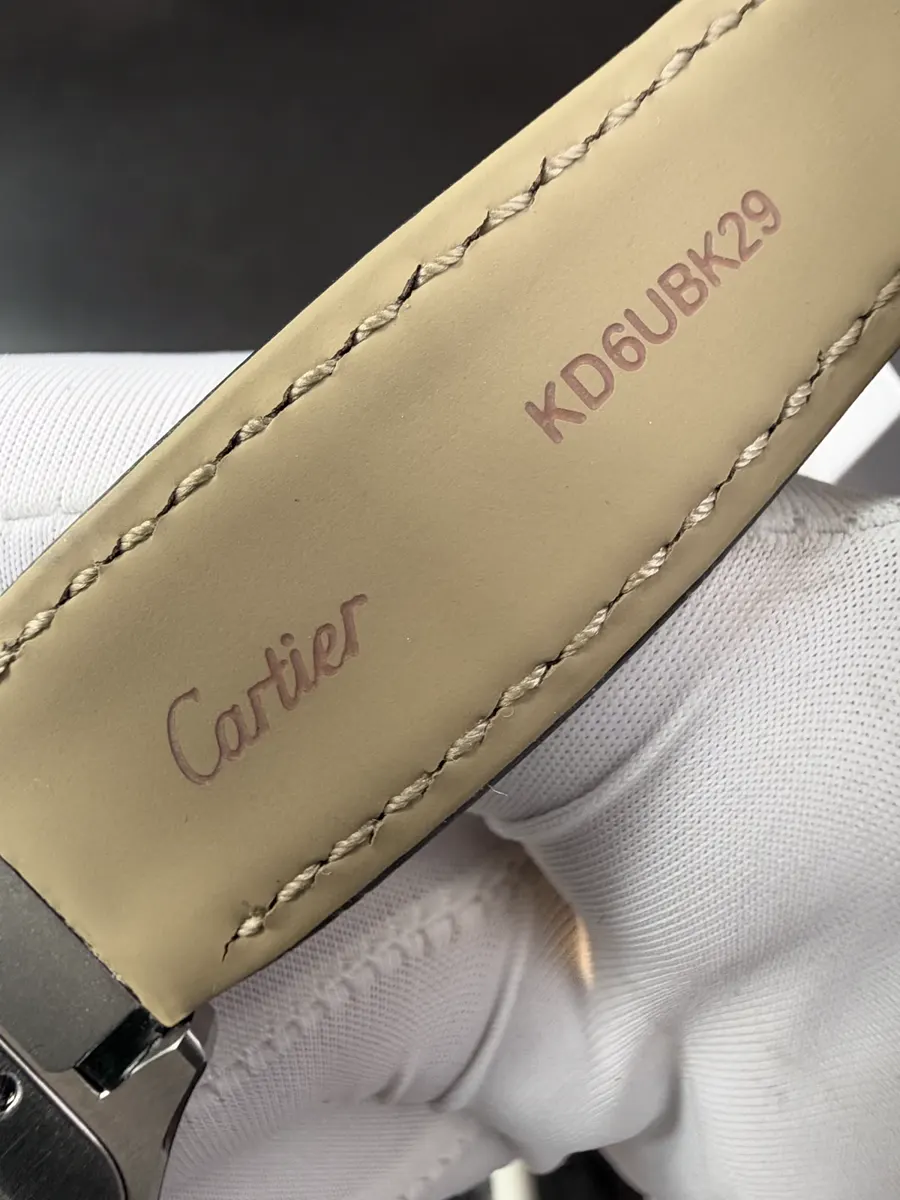
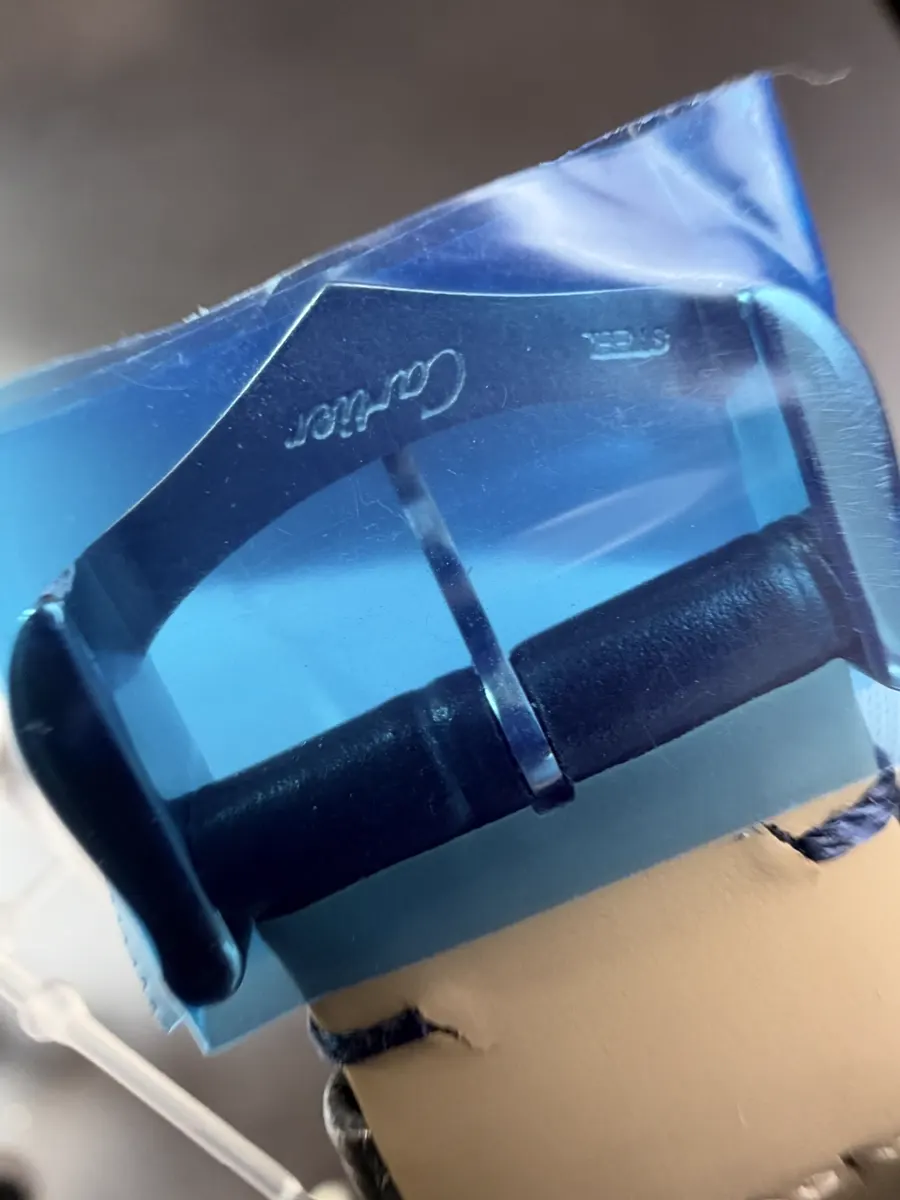
| Strap / buckle | 6/10 | IMG_2606: the “Cartier” script and the code are pressed evenly, and the stitching is regular, but the thread is fuzzy along both rows. IMG_2605, IMG_2602: the raw edge of the strap end at the lug is fibrous and frayed. IMG_2607: the buckle is still in its protective film, so we can’t judge its finish |
| Movement & timekeeping | not assessed | No timegrapher reading, no power-reserve test, base calibre unknown, solid caseback |
| Lume | not assessed | No dark shot. We can’t see any luminous plots on the dial (IMG_2603, IMG_2604), and Cartier’s spec page lists none |
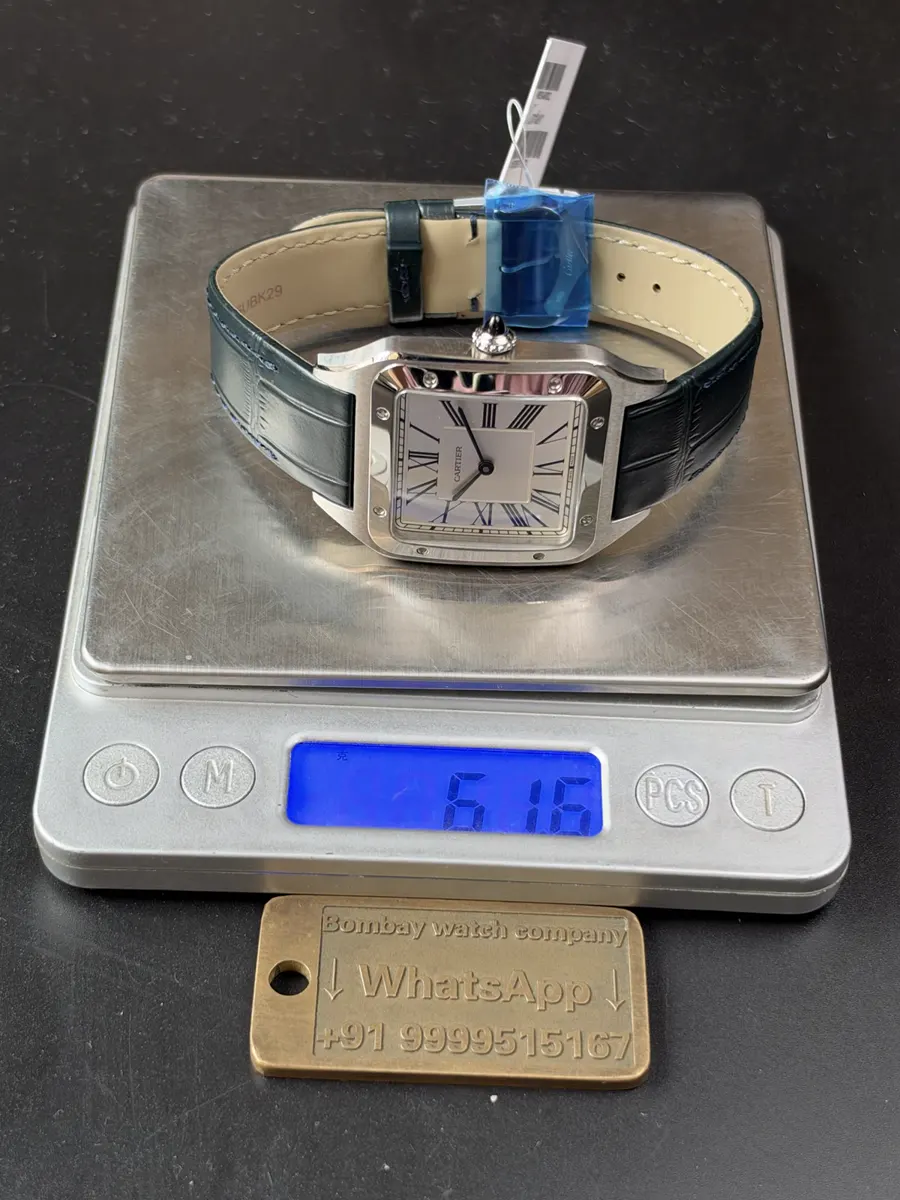
| Wearability | not assessed | No wrist photo. We weighed it at 61.6 g on the strap (IMG_2600), but Cartier publishes no weight to compare against, and a number on a scale isn’t the same as how it wears |
Against the gen: what to look at
- Thickness: the one difference that matters. The caliper reads 8.3 mm (IMG_2608). Cartier publishes 7.5 mm for the steel XL and 7.3 mm for the steel Large. Against the XL, that’s 0.8 mm extra, about a tenth thicker. On a sports watch nobody would notice. On a watch whose whole point is lying flat under a cuff, you may notice it from the side. Caveat: it’s one reading from one photo, and we haven’t measured the other two dimensions. For context, the gen gets its thinness from its movement: the 430 MC is the Piaget 430P, about 2.1 mm high, and the hand-wound XL came out only 0.2 mm thicker than Cartier’s 2019 quartz models.
- Hand-wound in a case whose size we haven’t checked. The caseback says “mécanique” (IMG_2605). Cartier makes a hand-wound steel Santos-Dumont in both sizes: the XL (WSSA0032, silver dial) and the Large (WSSA0046, black lacquer dial). As far as we can find, the silver-dial steel Large is quartz only. If a silver-dial “mécanique” measures at Large dimensions (about 43.5 x 31.4 mm), we found no Cartier reference that matches it. We haven’t measured ours, so this is something to check, not a verdict.
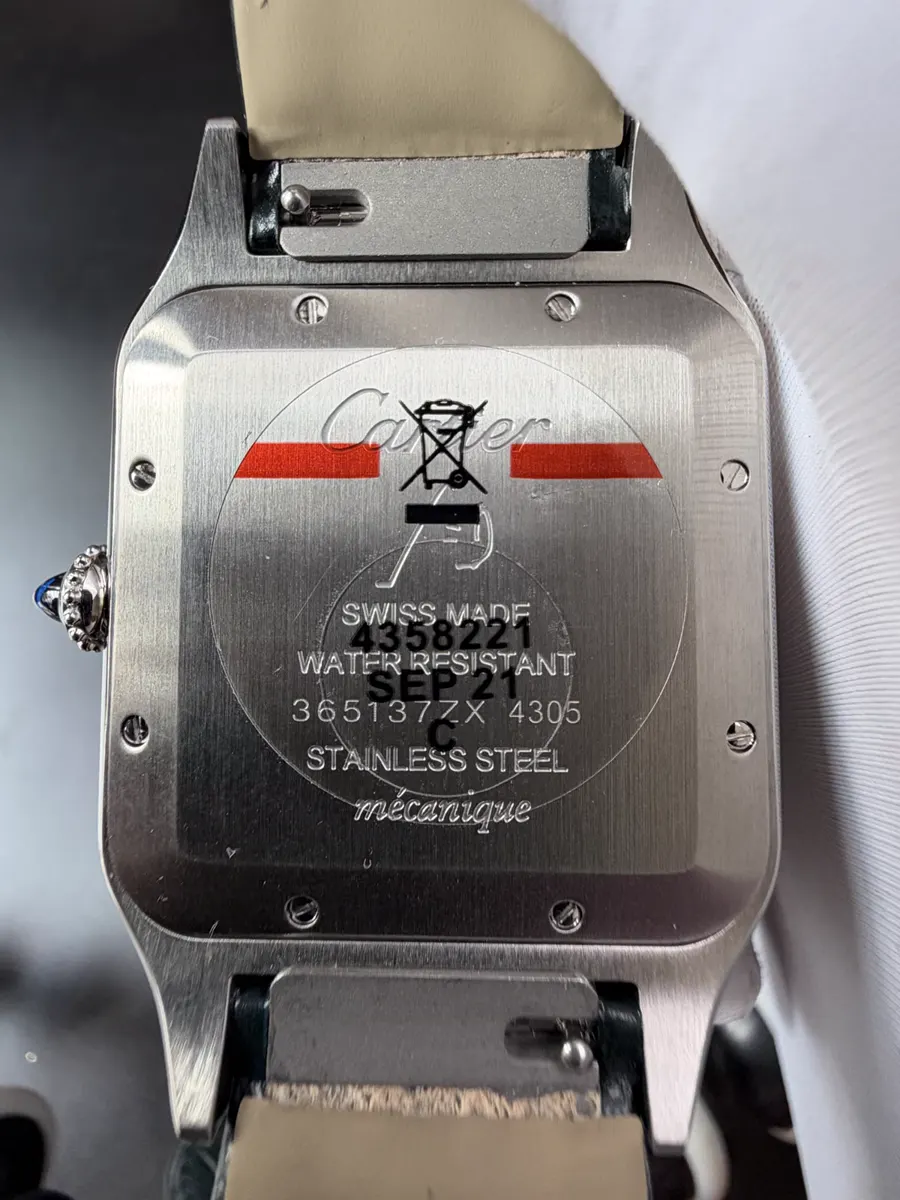
- The caseback text, described but not judged (IMG_2605). It reads, in order: Cartier script, a signature-style engraved mark, “SWISS MADE”, “WATER RESISTANT”, “365137ZX 4305”, “STAINLESS STEEL”, “mécanique”, with eight screws. One dealer listing of a gen WSSA0032 describes the same wording. We couldn’t find a reliable source for what the number line should read on this reference, so we’re not calling it right or wrong. Don’t let a convincing number convince you.
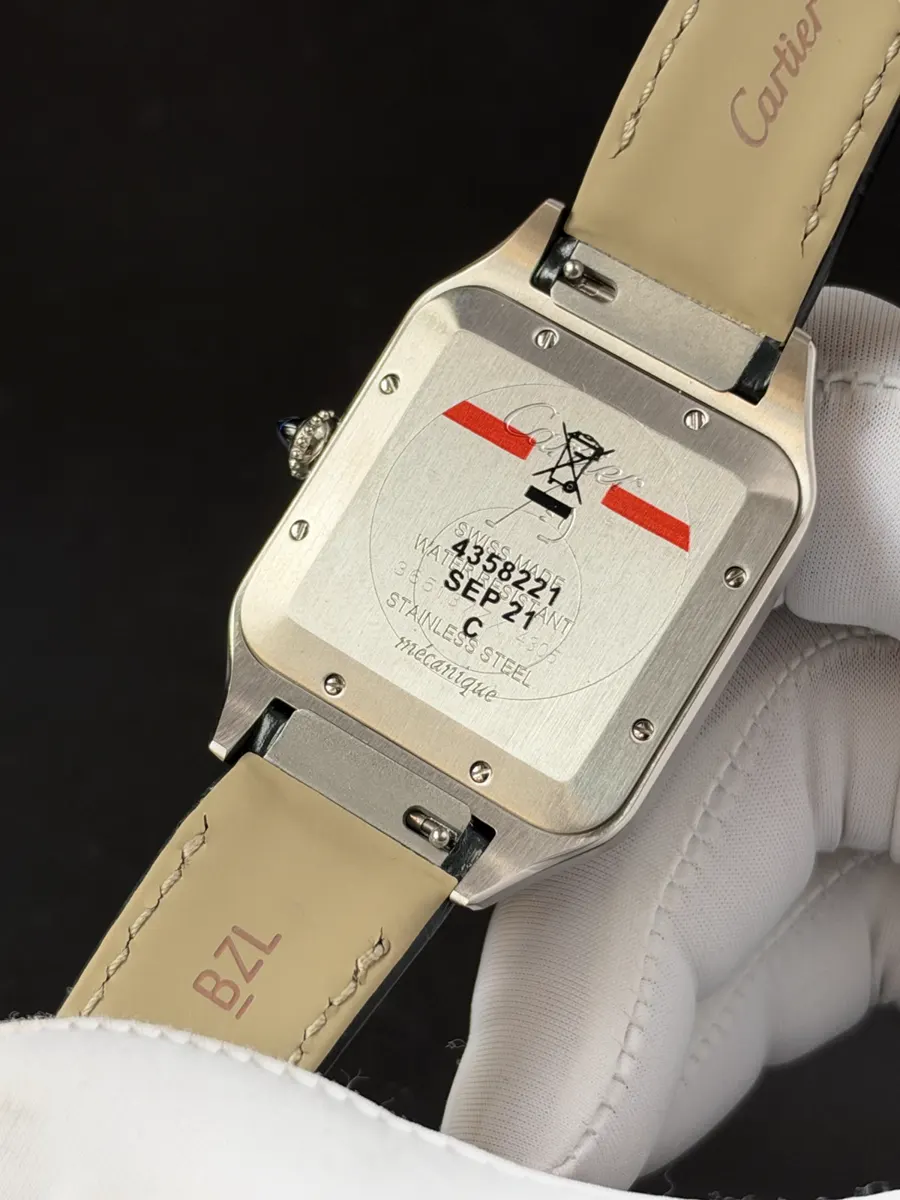
- The protective sticker, described but not judged (IMG_2594, IMG_2602). It’s a clear disc printed with two red bars, a crossed-out bin symbol, and “4358221 / SEP 21 / C”. We found no first-party source showing what Cartier’s caseback sticker looks like, so we’re making no claim. Stickers are the easiest thing to print. Treat them as packaging, not proof.
- Dial and hands match Cartier’s description. Cartier describes a satin-finish silver dial with a sunray effect, Roman numerals, blued-steel sword hands, and a beaded crown set with a blue synthetic spinel cabochon. Ours has each of those (IMG_2592, IMG_2603, IMG_2604, IMG_2593). We can’t confirm from photos that the cabochon is a spinel.
- Strap colour isn’t a tell. Cartier lists navy blue alligator. Ours photographs as a dark blue-green (IMG_2592, IMG_2601), but the lighting changes from shot to shot, and we haven’t tested whether the leather is alligator. Underneath it’s stamped “Cartier” and “KD6UBK29” (IMG_2606), and “BZL” near the lug (IMG_2594). We don’t know what those codes mean on a gen strap.
Known issues / QC to check on any example
- Thickness. Put a caliper on it. Ours read 8.3 mm. If thinness is why you want a Santos-Dumont, check this before anything else.
- Size. Measure length and width. A silver dial, hand-winding and Large dimensions together match no current Cartier steel reference we could find (see above).
- Strap edges and thread. IMG_2605 shows a frayed raw edge where the strap meets the lug, and IMG_2606 shows fuzzy thread. Fibres can be trimmed. An edge that keeps shedding won’t improve.
- Bezel screws. Look at all eight under a loupe for burrs or marks in the slots. Ours are clean but not aligned (IMG_2592).
- Winding. On any hand-wound watch, wind it gently and stop when you feel resistance. We haven’t timed this one or run it down, so we can’t give you a power-reserve figure.
- Water. The gen is rated to 3 bar. We haven’t tested this case. Treat it as a dress watch that stays dry.
What other owners report
None of this comes from our photos, and none of it changes our scores. It’s what we found on RWI, the longest-running rep forum, and in the factory’s own sales copy. RWI blocked us from reading the threads in full, so everything below comes from the parts of those threads that search engines index. Treat each point as one person’s report unless we say otherwise. We found no Reddit discussion of the F1 hand-wound version.
On F1’s hand-wound version specifically
- Nobody has identified the base movement. We found no teardown and no movement photo. The only description is F1’s sales copy, which is quoted in an RWI thread on the hand-wound XL: an “exclusive customized Asian version 430MC”, hand-wound, said to look about 90% like the gen movement. That’s marketing, not evidence. Owners don’t report a base calibre, and neither do we.
- Power reserve: 36 hours, but only in the sales copy. That figure comes from the factory’s description, not from anyone running one down. Cartier lists 38 hours for the gen 430 MC. We haven’t tested ours.
- One early owner was happy with it (single source). The person who started that RWI thread called the watch well made and described the amplitude as strong. They gave no figure, no timegrapher photo and no long-term follow-up.
- The hand-wound version surprised people (single source). A reply in the same thread said F1 was known for quartz Santos-Dumonts, so a mechanical one was unexpected. That suggests the hand-wound version is the newer one, but nobody we found has documented when it changed.
- Size worries (single source). One reader in that thread held back because the XL might be too big for their wrist. That’s a fit question, not a fault.
- The strap may not be alligator. F1’s sales copy lists the standard strap as calf leather pressed with an alligator pattern, with real alligator as an option. The same copy claims a sapphire crystal. Both are the factory’s claims. We haven’t tested either on ours.
On Santos-Dumont reps generally (other factories and the quartz versions)
- The CARTIER print can be thin (single source). In RWI’s long Santos-Dumont quartz thread, one member called the CARTIER lettering on the F1 dial an “instant tell” because it’s “not as bold (thick) as gen”. Others in that thread thought AF’s lettering was slightly heavier. It was posted in a thread about the quartz versions, so it may not apply to ours. We didn’t compare our dial against a gen, which is why the dial score stops at 8.
- Strap and caseback named as weak spots (one reply). In the same thread, one member who received a quartz rep praised its dimensions, cabochon, sunburst dial, sapphire crystal and blued hands, and called the caseback engraving excellent. Another reply named the strap and shallow caseback engraving as the weak spots. Our own strap shows fraying and fuzzy thread (IMG_2605, IMG_2606), so we can’t argue with the strap part.
- The stock strap is hard to replace (more than one owner). Several RWI members measured lug widths around 17.5 to 17.7 mm on their reps, depending on size and which side they measured. One found 18 mm aftermarket straps tight at the lugs, so measure before you buy.
- One thickness measurement from another rep (single source). One owner measured a Large-size rep (31.6 mm wide, 43.2 mm lug to lug) at 7.55 mm thick, against Cartier’s 7.3 mm for the Large. The excerpt doesn’t say which factory or movement it was. We found no thickness figure for F1’s hand-wound version anywhere, including F1’s own sales copy, so our 8.3 mm is the only number we know of.
Who should skip it
- Anyone who wants the Santos-Dumont because it’s thin. At 8.3 mm on our reading, it’s thicker than Cartier’s published figure.
- Anyone who needs to know the movement. The base calibre is unknown. Nobody else we found has identified it either, and we have no timing data yet.
- Anyone who wants to wind it once a week and forget it. It’s hand-wound, and we haven’t tested how long it runs.
- Anyone looking for a daily, all-weather watch. It’s a square dress case on a leather strap.
FAQ
Is it as thin as the real one?
No. Our caliper read 8.3 mm (IMG_2608). Cartier publishes 7.5 mm for the hand-wound steel XL. That’s 0.8 mm over the XL, 1.0 mm over the Large.
Is it hand-wound like the gen? What movement is inside?
The caseback says “mécanique”, and the gen steel XL is hand-wound (calibre 430 MC). We haven’t opened ours or timed it. F1’s sales copy calls its movement a customised “Asian version” of the 430MC with 36 hours of reserve, but we found no teardown or movement photo from any owner, so nobody has shown what the base calibre is.
Is it the Large or the XL?
We haven’t measured it yet. In steel with a silver dial, Cartier makes the Large in quartz and the XL hand-wound. A hand-wound steel Large exists, but only with a black lacquer dial. Measure any example: the XL is 46.6 x 33.9 mm.
Is the crystal sapphire?
Cartier uses sapphire on the gen, and F1’s sales copy claims sapphire too. We haven’t tested the crystal on ours. If you test one at home and get mixed results, the result is inconclusive. Don’t treat it as an answer either way.
Can I fit an aftermarket strap?
Possibly, but measure first. RWI owners report lug widths around 17.5 to 17.7 mm on their reps, and one found 18 mm straps tight. We haven’t tried another strap on ours.
How heavy is it?
61.6 g on our scale (IMG_2600), weighed on the strap with the buckle film and hang tag still attached. Cartier doesn’t publish a weight, so there’s nothing to compare it with.
Hands-on as of November 2026. Gen specifications from Cartier’s own WSSA0032, WSSA0046 and WSSA0085 listings. Owner reports are attributed and kept separate from our own photos. Fact-checked before publishing.
More hands-on reviews: all reviews · questions? talk to us