Red Flag Report
Factory rumour or factory news: how do you tell before you buy?
By swissreptime · current as of November 2026
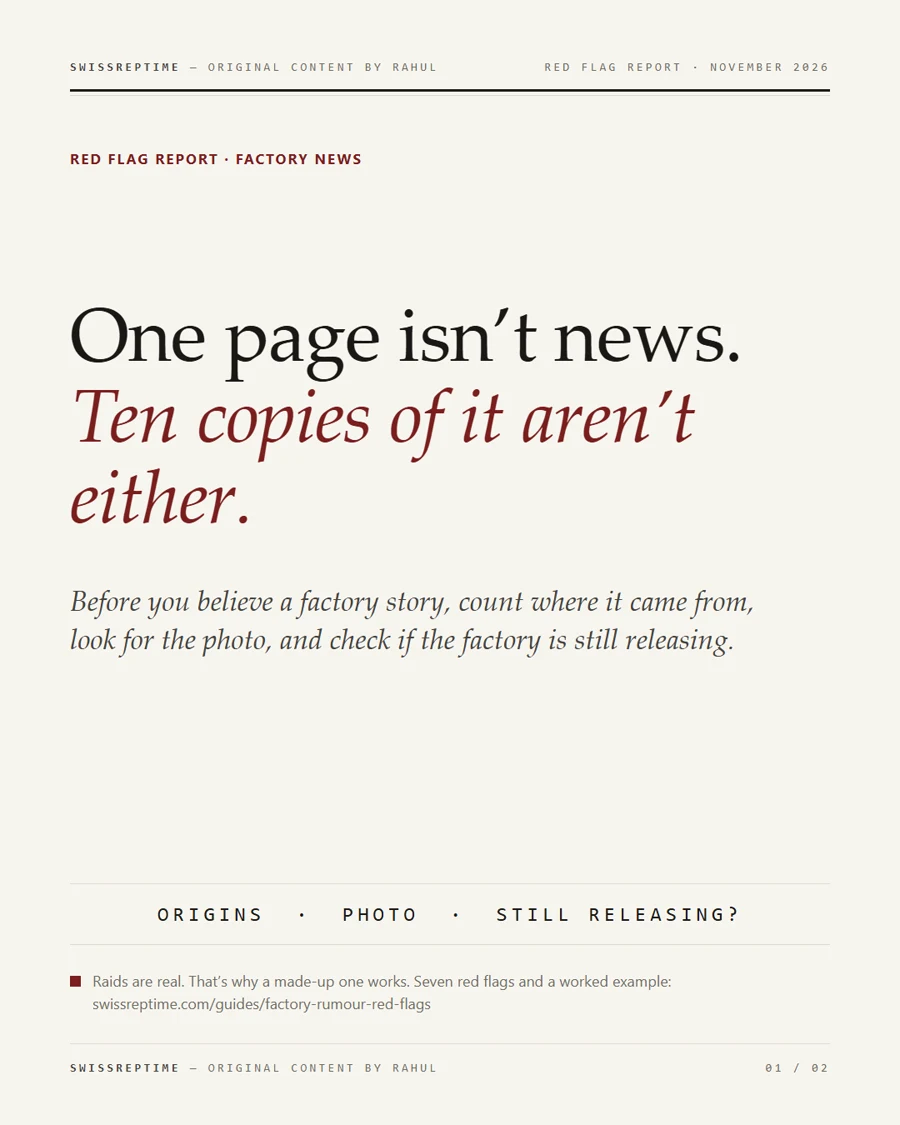
Before you believe a factory story, count where it came from. One page is not news. Ten pages copying that one page are still not news. Real factory news has three things: someone with no watch to sell saying it, a photo of the actual thing, and a factory whose behaviour fits the story. If a story has none of them, it’s a rumour. Make your choice as if you’d never read it.
If you haven’t bought your first rep yet, you’re probably reading a lot. Forum threads. Seller pages. “Factory updates.” Somewhere in there you’ll hit a headline saying the factory you were looking at got raided, or shut, or changed its name. It’ll feel urgent.
Usually it isn’t. Here’s how to check, using a story that went round recently and didn’t survive a basic look.
Do factories actually get raided?
Yes. Say that first, because being careful isn’t the same as saying nothing ever happens.
APS, once the name people gave for the Royal Oak 26240 chronograph, was raided and shut down in 2026. It’s closed for good. Forum threads earlier this year reported raids at three factories: VF, APSF and 3CF.
So the story you’re reading could be true. The point isn’t to disbelieve everything. It’s to know what a true story looks like, so the others stand out.
Raids are real. That’s exactly why a made-up one works.
The one that didn’t hold up
The story going round was that VSF had been raided and shut down. VSF is the factory behind a lot of the Submariner, GMT and Datejust reps you’ll be shortlisting, so if that were true, it would matter.
Here’s what’s actually on record.
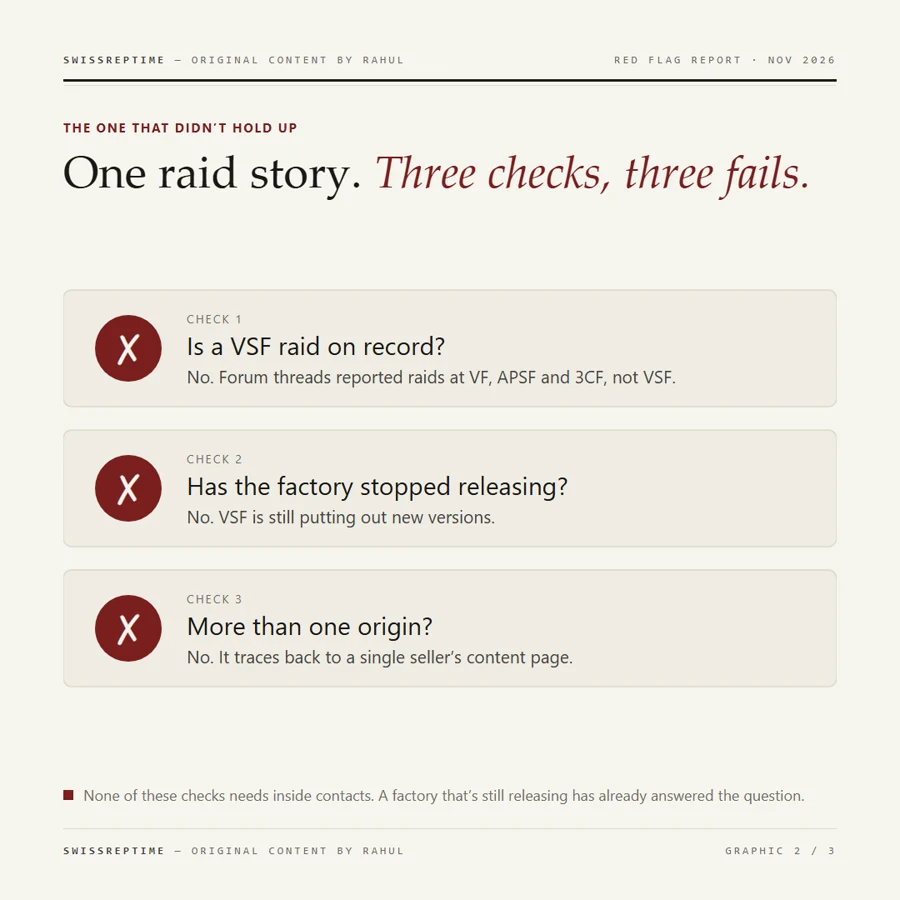
There’s no evidence VSF has been raided. No raid on record for VSF, anywhere we looked.
The raid threads name VF, APSF and 3CF. Not VSF. VF is a separate factory, not shorthand for VSF.
VSF is still putting out new versions. A factory that’s been shut down doesn’t release new versions. That one fact does most of the work.
And where did it start? A single seller’s content page. One page. When we traced it, that was the only origin left standing.
None of those checks needs inside contacts. Each one is something you can look up yourself. One seller’s page, against a factory that’s still releasing. That isn’t news.
Why do stories like this spread?
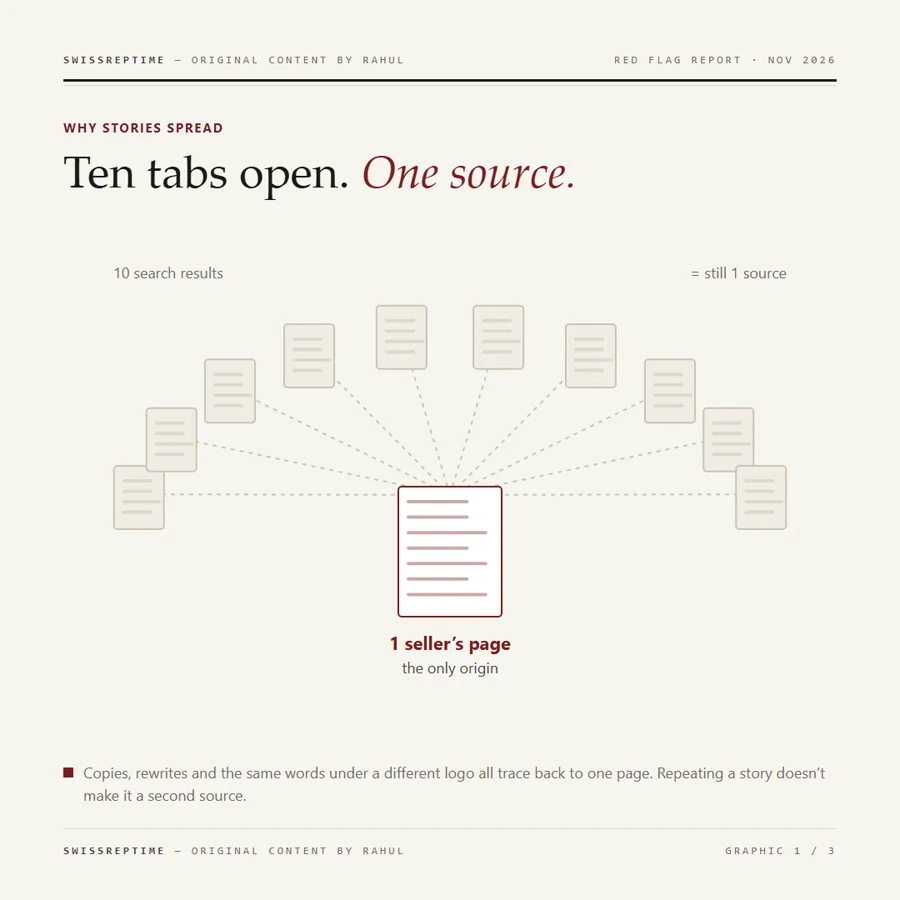
A seller’s content page exists to bring readers to a seller. A raid headline gets clicks. Then other pages pick it up, sometimes word for word, and a week later a search shows you the same story five times. It looks like five sources. It’s one.
Some of it isn’t even on purpose. Factory names are short codes, two or three letters, and they’re easy to mix up. Chinese listings get machine-translated, and some words come out meaning something else. A story can go wrong without anyone lying.
Repeating a story doesn’t make it a second source. Only a new pair of eyes does.
The red flags, one by one
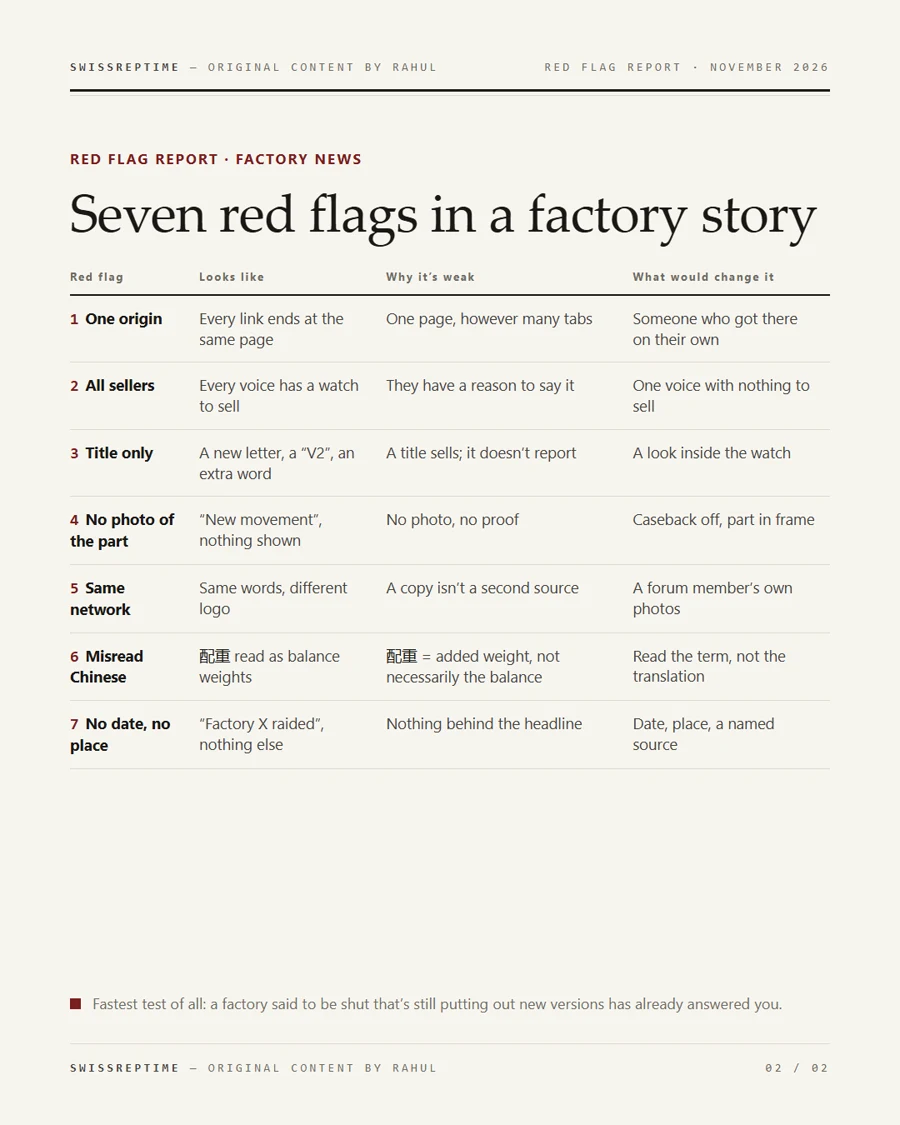
1. It has one origin. Trace it back. Click through to whoever the page cites, then whoever they cite. If every road ends at the same page, you have one source, however many tabs you’ve got open.
2. Every origin is selling something. Sellers aren’t always wrong. But a seller has a reason to say a rival’s factory is gone, or that their batch is the new one. If every voice in the story has a watch to sell, wait for one that doesn’t.
3. It’s a listing title and nothing else. A lot of “news” is just a product title. A new letter after a factory code, a “V2”, a word added to the name. A title is what someone typed to sell a watch. It isn’t a report on what’s inside it.
4. Nobody has photographed the part. If the claim is about a movement, a balance or a case, someone should have a photo of that exact part. If it’s inside the watch, that means a photo with the caseback off. No photo, no proof. When someone says a movement has changed, the question is simple: has anyone opened one and shown it?
5. The “second source” is the same network. Groups of seller sites post each other’s copy. Same claim, same wording, sometimes the same photos, different logo on top. That’s one origin. A real second source got there on its own: an owner who bought one and opened it, or a forum member posting their own photos.
6. A Chinese word got read wrong. One to know: 配重 (added weight). On VSF’s Daytona listings it refers to a weighted case, not weights on the balance wheel. The word alone doesn’t tell you which. Same word, two very different stories, and a machine translation won’t tell you which one you’ve got.
7. No date, no place, no photo. A raid story with no date, no city, no named source and no picture is a headline with nothing behind it.
Any one of these is a reason to wait. Two together, and you can stop reading.
So what does real news look like?
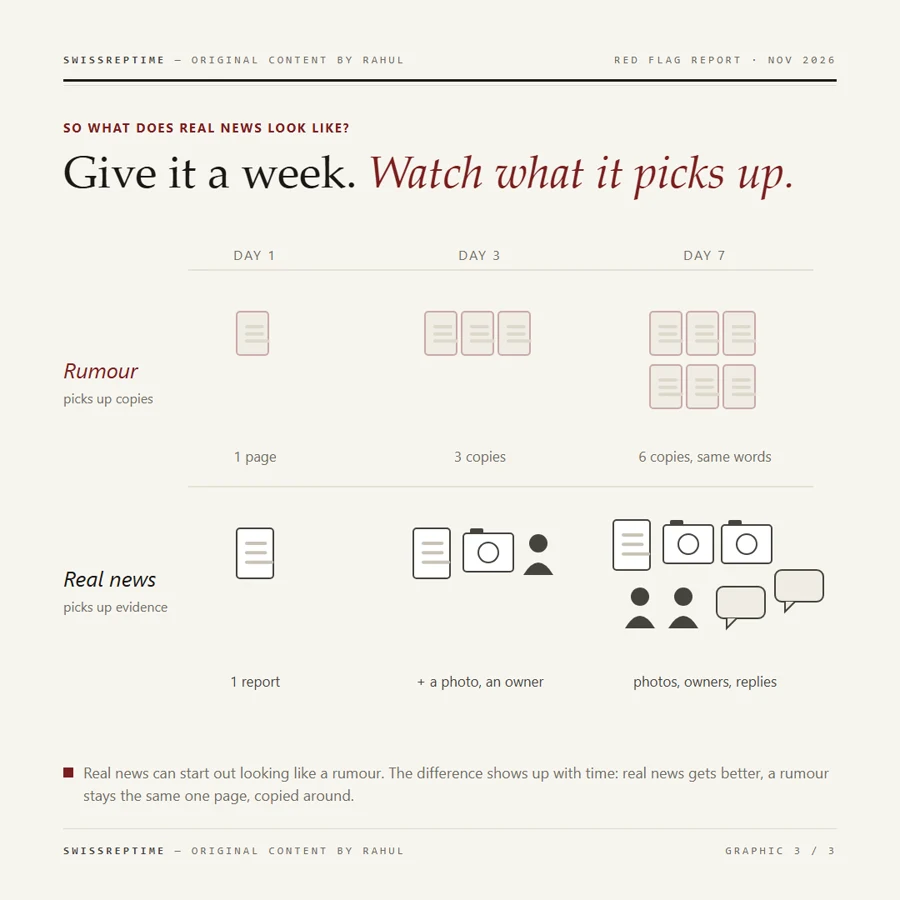
Turn the flags round. A story starts to look real when:
- someone with nothing to sell says it, in their own words
- there’s a photo of the actual part, or the actual watch
- a second person got there separately
- what the factory does fits the story
That last one is the quickest test there is. A factory said to be shut, that’s still putting out new versions, has already answered the question for you.
To be fair to rumours: real news can start out looking like one. You won’t always get all four of those on day one. The difference shows up with time. Real news gets better. A week later there are owner posts, photos, people arguing in the replies. A rumour stays the same one page, copied around.
Real news picks up evidence. A rumour just picks up copies.
What does this change if you haven’t bought yet?
A factory rumour pushes a first-time buyer one of two ways. Rush, because the factory might be gone tomorrow. Or drop a factory you spent weeks reading about, because a page said so. Both are decisions made for you by somebody else’s headline.
So, before you change your plan:
- Check if the factory is still releasing. If new versions are still coming out, the “shut down” story is in trouble already.
- Ask where the story came from. Whoever you’re talking to, ask for the source. A good answer is a link to an owner’s post with photos. “Everyone’s saying it” isn’t one.
- Give it a week. Real news is still there in a week, with more behind it. Rumours tend to just get copied.
- Judge your watch, not the headline. The QC photos of the actual piece you’d get tell you more than any story about the factory.
Count the origins. Look for the photo. Check if the factory’s still releasing. If a story fails all three, close the tab and get back to choosing a watch.
Read next: how to read a QC photo set before you pay · our hands-on reviews · questions? talk to us