QC Desk
Why are some reps thicker than the gen, and how do you check?
By swissreptime · current as of November 2026
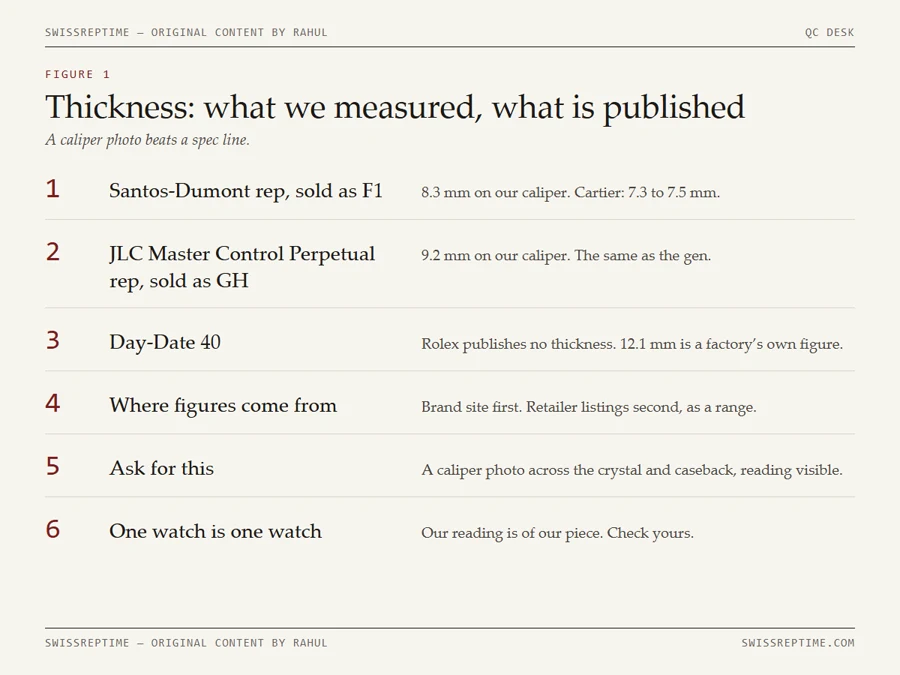
Width is easy to copy. Thickness is where reps drift. On our caliper, one rep read 0.8 to 1.0 mm over the brand’s figure, one read about a third of a millimetre over, and two matched it. A spec line cannot tell you which one you have. A caliper photo of your own watch can.
Why is thickness the dimension that drifts?
Width and length come from the case outline, and an outline can be copied from the original. Thickness comes from what has to fit inside: the movement, the dial and hands, the crystal, the caseback.
A rep does not carry the brand’s movement. If the movement inside is taller than the original’s, or a calendar module sits on top of a base calibre, the case has to grow to hold it. That is the general mechanical reason.
It cuts the other way too. The Breguet 5177 rep we reviewed runs a decorated Miyota 9015. Miyota lists the 9015 at 3.90 mm high. Breguet lists its own calibre 777Q at 3.8 mm. The gap is a tenth of a millimetre, and that case matched.
What did our caliper show on the watches we have handled?
Four watches. One reading each.
- Cartier Santos-Dumont rep, sold as F1: 8.3 mm. Cartier publishes 7.5 mm for the steel XL and 7.3 mm for the steel Large, so ours is 0.8 to 1.0 mm thicker, depending on which size it copies. We have not opened it and do not know the base calibre, so the cause is not established. We stock this watch. See our Santos-Dumont review.
- Jaeger-LeCoultre Master Control Perpetual Calendar rep, sold as GH: 9.2 mm, which is Jaeger-LeCoultre’s published figure. See the GH review.
- Breguet Classique 5177 rep, sold as MKS V3: 8.8 mm, the same as Breguet’s published figure. See the 5177 review.
- F.P. Journe élégante 48 rep: 8.3 mm against F.P. Journe’s 7.95 mm. About a third of a millimetre over.
Each is one reading from one photo of one watch. On ours, that is the number. It is not a promise about yours.
Where do “gen thickness” figures come from, and why are some of them wrong?
Three places, in this order of trust.
- The brand’s own page. Cartier, Jaeger-LeCoultre, Breguet, F.P. Journe and Patek Philippe print a thickness. Even here, look twice. Cartier’s page for the Santos de Cartier Medium says 8.83 mm in the description and 8.82 mm in the specification table. The Large is 9.38 mm in both. More on those two in Santos Medium vs Large.
- Retailer and reference listings. Rolex publishes no thickness for the Day-Date 40, so every thickness you read for that watch is somebody else’s figure. For the Submariner 124060, the figures in circulation are third-party listings too, at about 12 to 12.5 mm. Quote a range, not one number.
- A factory’s own sales copy. This is a measurement of the rep, not of the gen.
A figure goes wrong when it climbs that list. Somebody copies a factory number, drops the source, and it comes back as “gen spec”.
What happened with the Day-Date 12.1 mm figure?
Exactly that. 12.1 mm is VSF’s measurement of its own case. It drifted into circulation as a gen figure.
Rolex publishes no thickness for the Day-Date 40. Third-party sources put the 228238 at about 12.2 to 12.3 mm, and about 12 mm. So the RCF case, at 12.3 to 12.6 mm, is in line with the gen. It is not thickened. An earlier draft of ours argued the opposite, and it was wrong.
Our Day-Date is the VSF V2. We stock this watch.
How do I ask for a caliper photo, and how do I read one?
Ask in these words: a caliper photo of my piece, across the crystal and the caseback, with the reading visible.
Then check four things.
- The jaws. One on the highest point of the crystal, one on the caseback, held square. A tilted caliper reads high.
- The display. The number and the watch are in the same frame.
- The watch. It is the same piece as in your QC photos. See how to read a QC photo set.
- The comparison. Set the reading against the brand’s page, not against the listing.
How much difference will anyone see on the wrist?
From the front, none. Nobody reads thickness off a dial.
From the side it depends on the watch. On our Santos-Dumont, 0.8 mm is about a tenth thicker than the XL. On a sports watch nobody would notice. On a watch whose whole point is lying flat under a cuff, you may. We give no cut-off figure, because nobody has published one.
This is one of the gaps behind the word “1:1”; see what 1:1 actually means. For what else differs between two reps of the same model, see why rep prices differ.
What don’t we know?
- How any other example measures. Ours are single readings.
- Why our Santos-Dumont is thicker. The case has not been opened.
- How each brand takes its figure, and whether a domed crystal is counted.
- The PPF 5810. Nobody has published a measured thickness against the gen’s 6.9 mm.
- The width and length of our Santos-Dumont and élégante, and the diameter of our 5177. We did not measure them.
Read next: