Deep Cuts
Watch crystals explained: acrylic vs mineral vs sapphire, and why it’s the first thing to check on any rep
By swissreptime · current as of September 2026
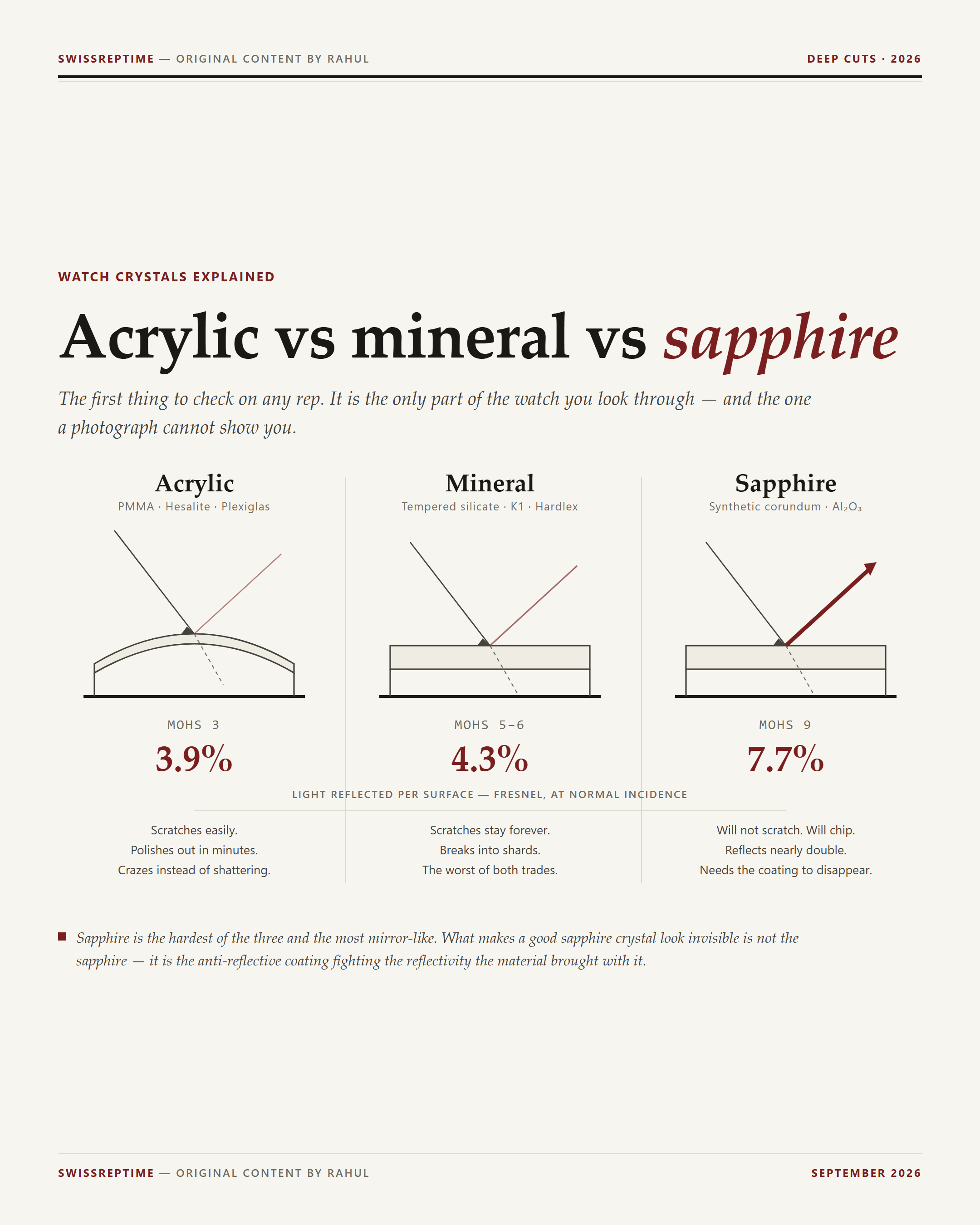
At the top tier the material argument is over — it is sapphire, and the real question is the anti-reflective coating, because sapphire reflects close to twice as much light per surface as mineral glass and the coating is what makes it disappear. At the cheap end the material claim is exactly where the lying happens. And on a vintage-style build, acrylic is the correct part and sapphire is the mistake.
The crystal is the only part of a watch you look through. Everything you use to judge a piece — the dial printing, the hand finishing, the date, the lume, the rehaut — reaches your eye after passing through it.
Get the crystal wrong and every other component is downgraded on the way out. That alone would make it worth understanding. What makes it the first thing to check is that it is also the cheapest place for a factory to save money, and the hardest thing to disguise in a photograph.
What the three materials actually are
Acrylic is polymethyl methacrylate — the same plastic sold as Plexiglas, Perspex and, when Omega says it, Hesalite. It sits around 3 on the Mohs scale, which means it scratches if you look at it hard. It also means a scratch buffs out with a tube of polish in about five minutes, which no other crystal material allows. And because it is a thermoplastic rather than a ceramic, it does not shatter: hit it hard enough and it crazes or deforms. It has a warm, slightly soft optical character, and a domed acrylic distorts the dial edge in a way people either love or cannot tolerate.
Mineral is tempered silicate glass — ordinary glass, heat-treated for strength. Mohs 5 to 6. It resists scratching considerably better than acrylic and considerably worse than sapphire, and it splits the difference in the worst possible way: scratches accumulate, and unlike acrylic they are permanent. Under hard impact it breaks into shards.
K1, which turns up in listings and is worth knowing, is heat-treated mineral glass pushed further — harder than standard mineral, more shatter-resistant than sapphire. Seiko’s Hardlex is the same idea under a brand name. It is a genuine middle option rather than a marketing word, though it is also the word a listing reaches for when it wants to sound like sapphire without saying sapphire.
Sapphire is synthetic corundum, aluminium oxide, grown in a furnace rather than dug up. Mohs 9, second only to diamond. Its Vickers hardness is around 1,940 measured parallel to the crystal’s c-axis and about 2,200 perpendicular to it — the material is anisotropic, so its hardness genuinely depends on which direction you attack it from. In practice nothing you meet in a normal day will scratch it.
Here is the concession, and it is the one the marketing never makes: hardness is not toughness. Sapphire is the hardest of the three and the most brittle. Drop a watch onto a tiled floor at the wrong angle and a sapphire crystal will chip or crack where an acrylic one would have shrugged. That is not a flaw in sapphire; it is the trade you are making. Omega still ships the Moonwatch with a Hesalite crystal for exactly this reason, and it is not because they cannot afford sapphire.
| Material | Mohs | Reflected per surface | Scratches | Under impact |
|---|---|---|---|---|
| Acrylic (PMMA / Hesalite) | ~3 | ~3.9% | Easily — but polishes out in minutes | Crazes or deforms. Survives. |
| Mineral (tempered silicate) | 5–6 | ~4.3% | Less easily — and permanently | Breaks into shards |
| K1 / Hardlex | Between mineral and sapphire | ~4.3% | Better than mineral | Better than sapphire |
| Sapphire (synthetic corundum) | 9 | ~7.7% | Effectively not, in normal use | Chips or cracks |
The half of the story nobody puts in the listing
Everything above is about scratching. The more interesting property is optical, and it runs the other way.
Sapphire has a refractive index of about 1.77. Mineral glass is about 1.52, acrylic about 1.49. The higher the refractive index, the more light bounces off the surface instead of passing through it, and the amount is not a matter of opinion — the Fresnel equation gives it directly. At normal incidence, reflection off a single surface works out at roughly 3.9 percent for acrylic, 4.3 percent for mineral, and 7.7 percent for sapphire.
So sapphire throws back close to twice as much light per surface as mineral glass, and a crystal has two surfaces. You will see a smaller figure quoted around the web — 15 to 20 percent is the common one — but run the numbers yourself and the gap is far wider than that.
Read that again, because it inverts the usual assumption. Bare, uncoated sapphire is a worse window than coated mineral. It is a harder window, and a more mirror-like one. The reason a good sapphire crystal looks like there is nothing there at all is not the sapphire. It is the anti-reflective coating on it, which exists specifically to fight the reflectivity the material introduced.
So when a factory advertises sapphire and says nothing about coating, it has told you about the scratch resistance and nothing about how the watch will actually look on your wrist. Those are different questions, and only one of them is visible across a room.
Why acrylic is not a downgrade — and when sapphire is a mistake
Rolex fitted acrylic to everything for most of its history. The first Rolex with a sapphire crystal was the reference 5100 in 1970. The first sports model to get one was the Sea-Dweller 16660 in 1978, followed by the Submariner Date 16800 in 1979. The no-date Submariner did not switch until the 14060 in 1990, and the whole catalogue was not on sapphire until around 1991. Two decades, one model at a time.
Which means that for any reference designed before that change, acrylic is not the budget option — it is the correct one. A vintage-style build wearing a flat sapphire crystal is wrong in the same way a 1680 with a ceramic bezel insert would be wrong. The warm, domed, slightly distorting look of acrylic is a large part of why those references read as vintage at all, and swapping it for sapphire removes the single most characteristic thing about how the watch catches light.
This is the one place in the hobby where the cheaper material is the accurate one, and the upgrade makes the watch less right.
So what is actually on a rep?
At the top tier, the answer is sapphire and the question has stopped being interesting. Spend an hour searching the crystal discussions on r/RepTime and you will notice something: essentially nobody is arguing about sapphire versus mineral. Every thread is about which sapphire — factory stock against a specialist aftermarket crystal against a genuine one, single anti-reflective coating against double, whose blue cast is worse under daylight. The material debate is absent because at that level nothing else gets shipped. That absence is the evidence.
At the cheap end it is the opposite, and this is where the word does its lying. “Sapphire” is the easiest spec to claim and one of the harder ones for a buyer to disprove. Watch for “sapphire-coated”, too, which is a thin sapphire layer deposited on mineral glass — technically not a lie, functionally a mineral crystal with a better vocabulary.
Being honest about the limits here: nobody has taken a statistical sample of budget pieces and verified the claims instrument by instrument, so I cannot give you a failure rate. The sensible default is the same one that applies to any unverifiable spec — treat a sapphire claim on a cheap watch as unproven rather than as either true or false, and check it yourself when it arrives.
How to actually check, and which tests are folklore
The scratch test. It works. It also permanently marks your watch, which makes it a decision rather than a test. If you are willing to do it, you already know the answer you expect.
The thermal tests. These are the ones with real separation behind them, because sapphire conducts heat far better than glass does. Hold the crystal to your forehead or cheek: sapphire feels noticeably colder and stays cold longer, while mineral warms almost immediately. Better, breathe on it — sapphire pulls the heat out of the condensation and clears the fog visibly faster than mineral does. The catch on both is that you need a known reference piece in the other hand, because “feels cold” means nothing without a comparison.
The one that settles it. A diamond tester, the pen-shaped tool jewellers use, reads thermal conductivity — which is exactly the property where sapphire and mineral are far apart. It is non-destructive, it takes a second, and it is the only method on this list that gives an answer you can rely on without a control sample. If you buy more than one or two watches a year, own one.
Everything short of a thermal reading is a guess with a ritual attached.
Why it goes first on the checklist
Three reasons, in order of how much they will cost you.
It is the layer everything else is judged through. A cloudy, over-reflective or badly coated crystal does not just look bad on its own — it makes a good dial look flat, kills the depth of applied markers, and washes out lume. People blame the dial for what the crystal is doing.
It is the most reliable cheap tell of where a watch actually sits. The crystal is invisible in a straight-on listing photo and expensive to do properly, which makes it the first place a corner gets cut. A factory that spent money here generally spent it elsewhere too.
And it is the component a QC photo cannot show you. Reflection behaviour only reveals itself with movement and changing angles — a single flat-lit still is precisely the condition under which a poor crystal looks fine. So ask the dealer for a short video, outdoors or near a window, tilting the watch through the light. The cast will show up immediately if it is there. If a QC set comes back as nothing but flat overhead stills, you have not seen the crystal at all.
Whether it is then worth replacing is a separate question, and one with a more complicated answer than most people expect — the genuine crystal is not automatically the upgrade it is sold as, and a good aftermarket one captures most of the difference. That is covered in the gen swaps guide.
Bottom line
Know which material belongs on the reference before you judge what is fitted. Modern piece: sapphire, and then ask about the coating, because the coating is doing the work the material gets credit for. Vintage-style piece: acrylic, and a sapphire fitted to it is a mistake somebody else made for you.
Ask for angled daylight video rather than flat stills, every time. It takes the dealer thirty seconds and it is the only way the crystal can be seen at all.
And if a spec sheet says sapphire and says nothing else, understand what you have been told. You have been told the watch will not scratch easily. You have not been told it will look good.
Current as of September 2026. The materials do not move. What moves is which tier ships which coating — updated as that shifts.
Read next: Which gen swaps are worth it · rep power reserve, explained · how to read a QC photo set · the full index
Share your experience
Tested a crystal and found the listing was wrong? Post what you had and how you checked it. Comments are moderated before they show.