Buyer's Edge
Why does my automatic watch stop overnight?
By swissreptime · current as of November 2026
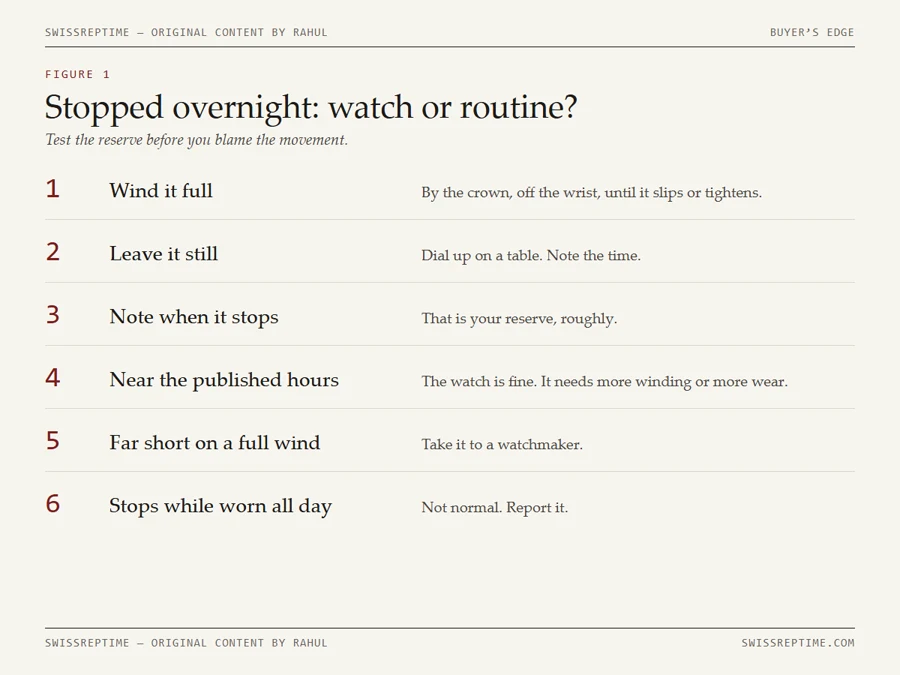
An automatic that is dead in the morning can simply be under-wound. A day at a desk moves the rotor very little, and the spring runs down at the same pace all night. Wind it fully by the crown and time how long it runs. Close to the published hours means the watch is fine.
How does an automatic store power, and how much does a day at a desk put in?
The power sits in a coiled mainspring inside a barrel. A weighted rotor swings as your wrist moves and winds that spring. On a movement with hand winding, the crown winds the same spring.
We have not found a published figure for how much a desk day puts into any rep movement, so we will not give one. The rotor winds through reduction gearing, so wrist movement puts in far less than the same effort at the crown. Typing hardly moves the rotor at all.
Two owners of the VS3235, the 3235-pattern movement in VSF watches, never wound by hand and reported 30 to 40 hours in the watch. Timed from a full hand wind, the same movement ran 67 to 68 hours in two owner tests. The detail is in what changed inside the Dandong movement.
A new watch can be the worst case. If it has sat unworn in its box, it has run down. A few shakes start it, but they put in very little.
How many hours should a full wind last?
Use the maker’s figure for the movement, not a listing.
- Rolex calibre 3235: about 70 hours, the published figure for the original.
- Miyota 9015: approximately 42 hours, on Miyota’s own specification page.
- VS3235 (in VSF watches): 67 to 68 hours in two owner-timed tests recorded on our page above. Other movements sold as a 3235 can run well short of this.
Ask which movement is in yours before you compare.
How do I wind it by hand, and can I overwind it?
- Take the watch off your wrist.
- If the crown screws down, unscrew it first.
- Turn the crown in the winding position, with slow, even turns.
- Screw the crown back down when you finish.
One owner on our power-reserve page reached 67.3 hours from about 40 turns. Treat 40 as a starting point, not a measurement.
You cannot overwind an automatic by the crown. The outer end of its mainspring is not fixed. It carries a bridle that slides along the barrel wall once the spring is full. You may feel the winding turn slightly gritty at that point. That is the slip, and it is normal.
A hand-wound watch is different. Its mainspring is attached to the barrel wall, so the crown stops when the spring is full. Never force it.
How do I test whether it is the watch or my routine?
- Wind it full by the crown, off the wrist.
- Lay it dial up on a table and leave it alone. Note the time and the date.
- Note when it stops. If you miss the moment, the hands and the date show roughly when.
This is a rough check, not a measurement. If the watch ran close to the published hours, the movement is fine and the routine is the cause. Wind it by hand when you put it on, or wear it for more of the day. If it ran far short on a full wind, take it to a watchmaker.
Which signs mean a real fault?
- It stops on the wrist during a full day of wear.
- It runs far short of the published hours after a full hand wind.
- It started stopping after a drop.
Two things are not on this list. Magnetism makes a watch run fast, which is a different symptom: see accuracy and regulation. And odd timekeeping in the last hours before a stop is the reserve running out: see what changes at the end of the power reserve.
What should I tell the seller or the watchmaker?
- The movement the watch was sold with.
- The hours it ran from a full hand wind, lying still.
- Whether it stops on the wrist or only off it.
- How the crown felt when winding.
- Any drop or knock.
If the watch is new, run the test in the first days, alongside our arrival checklist. For bench work, see rep repair in India. A reserve that has shortened over the years is a service question, covered in how long a rep automatic lasts.
What don’t we know?
- How much a desk day winds any rep movement. We have not found a published figure.
- The full-wind reserve of rep movements other than the ones timed on our power-reserve page.
Read next: